GuidesFace contouring
Wide lower face: is it bone, muscle, buccal fat or sagging?
A wide lower face can come from the jaw bone, a large chewing muscle (the masseter), buccal fat in the lower cheeks, fat along the jaw and under the chin, or sagging jowls, and often from a mix. Each responds to a different treatment, so find the cause before choosing jaw Botox, fat removal or a lift.

What makes the lower face look wide?
The width you see in a mirror is the sum of several layers. Bone sets the frame: the angle of the jaw below each ear and the shape of the chin. The masseter, the chewing muscle that runs from the cheekbone down to the jaw angle, sits on the bone at the back of the jaw. Fat lies in front of and below it, in the lower cheeks, along the jawline and under the chin. Skin covers it all, and with age it loosens and drops into jowls.
Two faces of the same width can need very different treatments. Removing fat from a face whose width is mostly muscle changes little. Removing fat from a face that has started to sag can make the sagging look worse.
For the lower face, Urban Plastic Surgery, our partner clinic, treats the soft tissue: muscle, fat and skin. It does not do facial bone contouring such as square jaw reduction or V-line surgery, so this guide covers bone contouring as background only. The options the clinic does offer are on our page about face contouring without bone surgery.
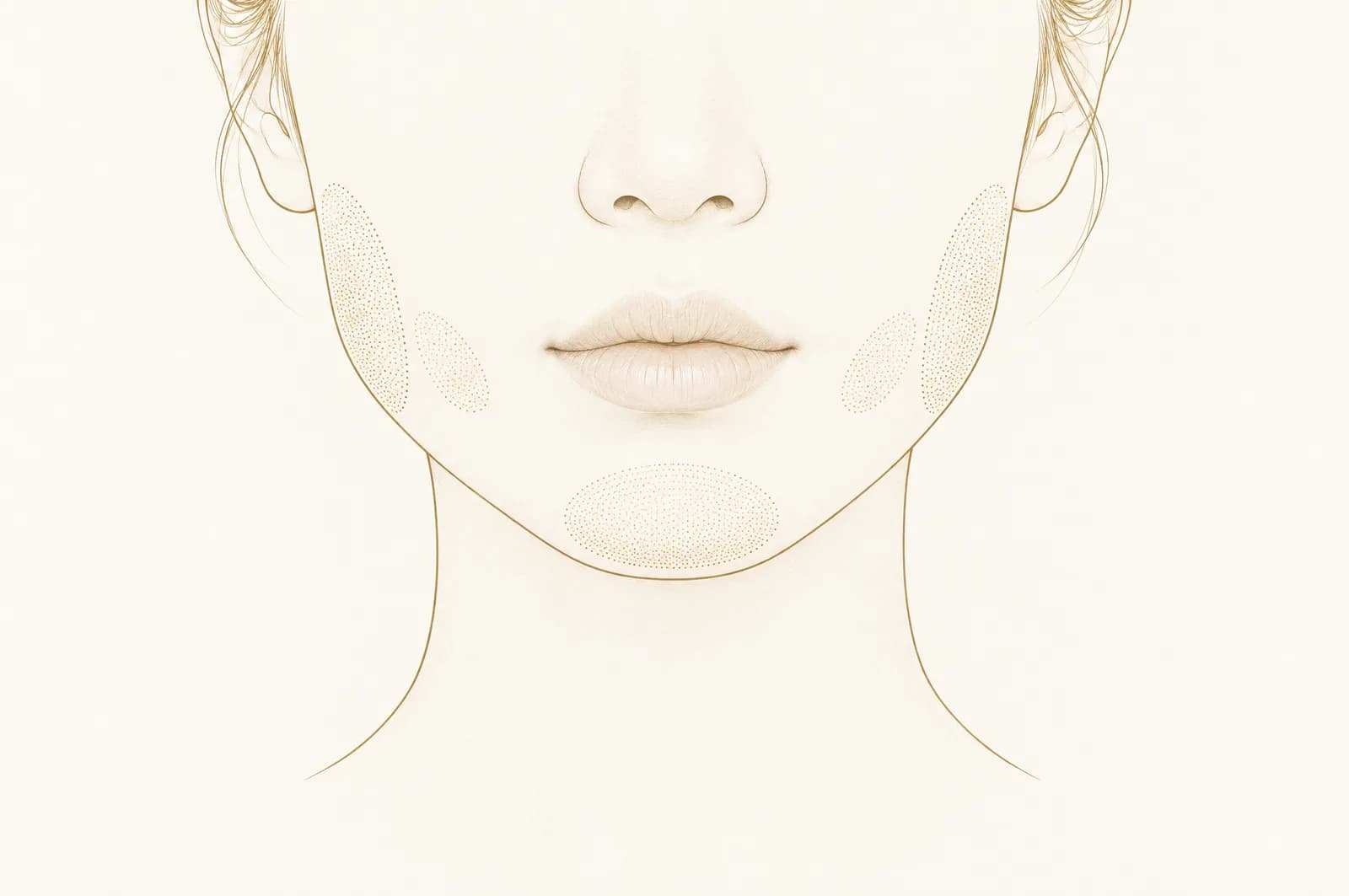
How can you check which cause is yours?
These checks take a few minutes in front of a mirror. They help you describe your face at a consultation. They are not a diagnosis, and a surgeon may read your face differently after an exam.
- Clench test for the muscle. Rest your fingertips on your cheeks just in front of your earlobes, then clench your back teeth. If a firm bulge pushes out under your fingers, the chewing muscle is part of the width.
- Relaxed jaw check for bone. Let your teeth part slightly and feel the corners of your jaw. A hard, angular edge that stays wide while the muscle is relaxed points to the bone shape. Only an exam with X-ray or CT images shows the bone itself.
- Pinch test for fat. Gently pinch the skin along your jawline and under your chin. A thick, soft roll that you can hold between your fingers is fat.
- Cheek check for buccal fat. Look for soft, round fullness in the lower cheeks, between the corner of the mouth and the muscle, that stays even when you are slim. Some people say it looks as if they are holding a hard candy in each cheek.
- Lift test for sagging. Face the mirror and gently push your cheeks up and back toward your ears. If your jawline looks sharper, loose skin and tissue are part of what you see.
- Age and weight check. If the width appeared gradually over the years, or comes and goes with your weight, fat or sagging is a more likely cause than bone.
Which treatment matches each cause?
Downtime below is what the partner clinic lists, or the general guidance on our procedure pages. Your own plan can differ, and many faces fit more than one row.
| Cause | How it looks or feels | Options | Typical downtime |
|---|---|---|---|
| Large chewing muscle (masseter) | Width at the jaw corners that hardens and bulges when you clench | Jaw Botox | Back to your day straight away. The slimming builds slowly and is most visible at around 3 months |
| Buccal fat | Soft, round fullness in the lower cheeks, even at a healthy weight | Buccal fat removal | You can go about your day afterwards, the clinic says. The procedure itself takes about 30 minutes under local anesthesia. Ask how long cheek swelling lasts |
| Fat along the cheeks and jaw | Soft fat you can pinch along the lower cheeks and jawline | Face liposuction, or fat-dissolving injections for small areas | Back to normal activities in about 1 week after liposuction, with stitches out on day 7 to 10 |
| Double chin or neck fat | Fullness under the chin and a soft line between jaw and neck | Double chin surgery | About 7 days after the thread method, the clinic says. Ask how long liposuction or muscle tightening needs |
| Sagging jowls | Tissue that drops below the jawline and lifts when you push the cheeks up | Thread lift, mini facelift or SMAS facelift | Little downtime after threads, about 1 week after a mini facelift, 1 to 2 weeks after an SMAS facelift |
| Hollow temples or cheeks | A thin upper face that makes the jaw look heavy in comparison | Facial fat grafting | About 1 week, with stitches out on day 7 to 10 |
| Wide jaw bone | Hard, angular jaw corners that stay wide when relaxed | Square jaw reduction or V-line surgery, which the partner clinic does not offer | A longer recovery after surgery under general anesthesia |
When is the chewing muscle the cause?
A large masseter makes the lower face look wide toward the back, at the corners of the jaw. At rest it feels like a soft swelling near the angle of the jaw, and it turns firm when you bite down.
Jaw Botox, also called masseter Botox, relaxes part of the muscle with small injections, and the muscle slowly gets smaller because it works less. At the partner clinic it takes under 10 minutes with numbing cream, and you can go back to your day afterwards. Reviews of the research describe the most change at around 3 months and an effect that lasts about 6 to 12 months, so it is usually repeated to keep the result.
Jaw Botox works on muscle only. It does not narrow bone or remove fat, so if the clench test shows little muscle, expect little change. Because it is quick and wears off, some people try it first to see how much of their width it explains. Side effects to ask about include bruising at the needle points and chewing that feels weaker for a while.
When is it buccal fat?
Buccal fat is a pad of fat deep in each cheek, below the cheekbone and separate from the fat just under the skin. When it is large, the lower cheeks look round and full even in people who are slim elsewhere.
Buccal fat removal takes out part of this pad through a small cut inside the mouth, so the scar is not on the face. The partner clinic lists about 30 minutes under local anesthesia, no hospital stay and no stitches to remove.
It does not suit every face. The American Society of Plastic Surgeons notes that it is usually not done for people with thin, narrow faces, because the face can look hollow with age. Reviews also point out that long-term results are not well studied. Reported problems are uncommon but include bleeding, infection, uneven cheeks, taking out too much, and injury to the salivary duct or a branch of the facial nerve.
When is it fat along the jaw or under the chin?
Fat just under the skin can collect along the lower cheeks, at the jowl area and under the chin. This is the fat you can pinch, and it often changes with your weight.
Face liposuction removes it through tiny openings with a thin tube. The partner clinic lists about 30 minutes to 1 hour under sedation, stitches out on day 7 to 10 and a return to normal activities after about 1 week. It suits a face that looks full or heavy from fat while the skin is still firm. If the fat has dropped and the skin has loosened too, ask whether a lift should come first or be done at the same time.
Under the chin, double chin surgery removes fat and, when the neck muscle is loose, tightens it through a short cut under the chin. The clinic also offers a thread method under the jaw, and its figure of about 7 days back to daily life is for that method only. Ask how long your own method needs; most people plan about a week in Seoul. For a small pocket of fat, the clinic also offers fat-dissolving injections; ask which product is used, what change to expect and how many sessions they would plan.
Liposuction removes fat but does not tighten skin. If your skin is already loose, taking fat away can leave it hanging, and a lift may be the better first step. After face liposuction or double chin surgery, swelling, bruising, numbness and uneven contours are possible.
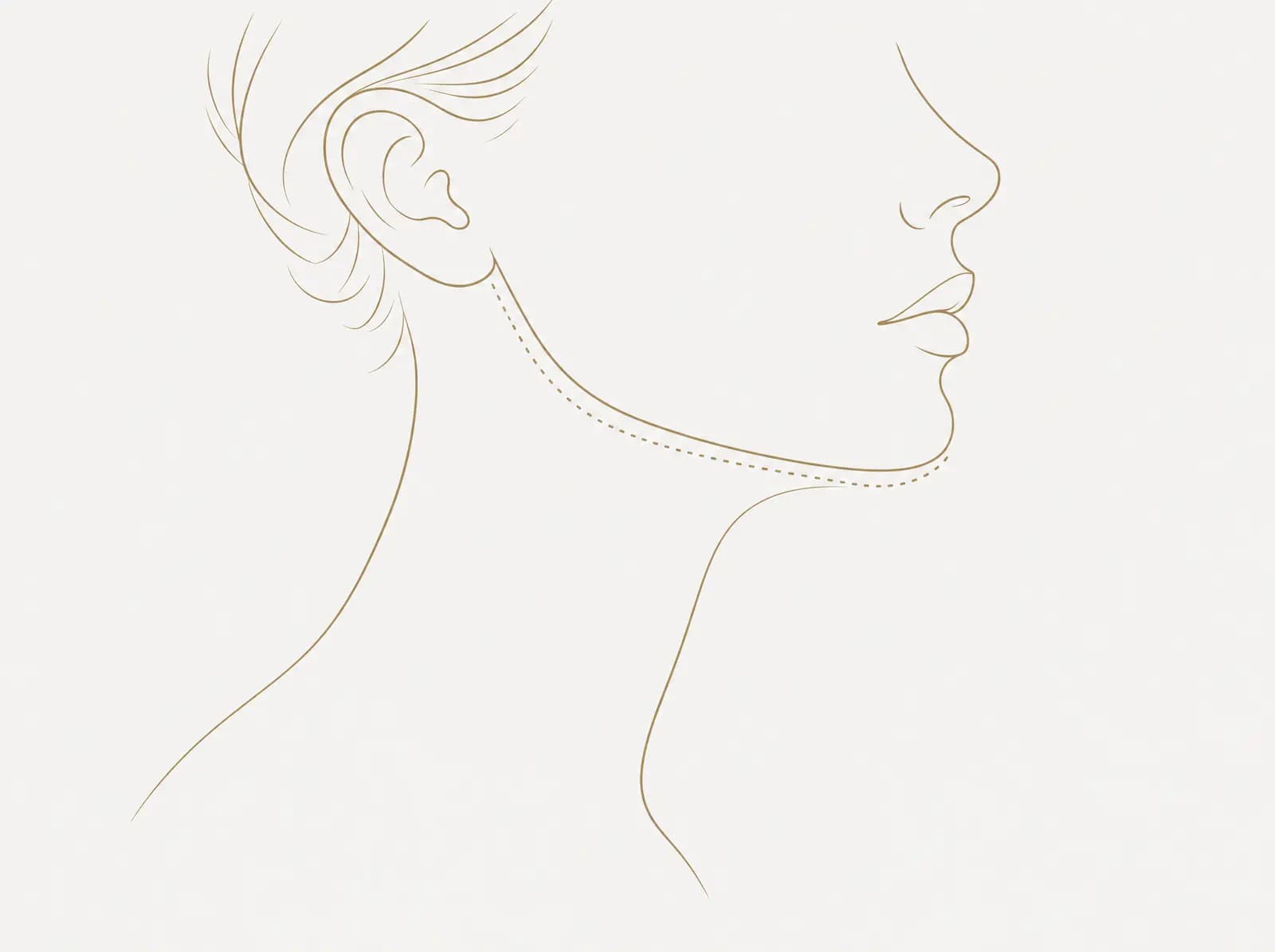
What if sagging or a thin upper face is the cause?
With age, the skin and the tissue beneath it loosen and slide down. Fullness that once sat on the cheek ends up along the jawline as jowls, and the lower face looks wider and squarer even though nothing has grown.
Sagging needs lifting. A thread lift suits mild sagging and takes about 30 minutes under local anesthesia at the partner clinic. A mini facelift lifts the lower face through a short incision, and most people return to normal activities after about 1 week. An SMAS facelift treats the mid face, lower face and neck together and needs 1 to 2 weeks of recovery before normal activities. Our guide to surgical and non-surgical lifting explains where each one stops working.
Sometimes the lower face looks wide because the upper face is thin. Hollow temples or flat cheeks make the jaw look heavier by comparison. Adding volume higher up with facial fat grafting can balance the face without touching the jaw. The partner clinic does it under sedation in 30 minutes to 1 hour, with stitches out on day 7 to 10.
What if the jaw bone itself is wide?
When the jaw corners are wide because of the bone itself, soft tissue treatment cannot narrow them. Bone width is changed with facial bone contouring surgery. Square jaw reduction trims the jaw angles, usually through cuts inside the mouth. V-line surgery reshapes the jaw angles and the chin together for a narrower, tapered lower face.
These are larger operations under general anesthesia, with a longer recovery than any option above. In one published review of 588 jaw reshaping cases over 5 years, the most common problem was numbness of the chin, lower lip or inside of the mouth, followed by infection. Most of the numbness had settled by 1 year, though not in every patient.
Because the partner clinic does not do facial bone contouring, we can share information about it but cannot arrange it. Before choosing bone surgery, rule out muscle and fat, since many faces have more than one cause. If you have already had bone contouring and the skin sagged afterwards, the clinic offers lifting after facial contouring, about 2 to 3 hours under sedation, with 2 to 3 weeks before you are back to normal activities.
How do you plan treatment from abroad?
Start with photos from the front, both sides and both angled views, with your face relaxed, then the same views while clenching. Send them with your age, any past fillers, Botox or thread lifts, and what bothers you most. A patient coordinator answers first, then the surgeon at the partner clinic that fits your case reviews your photos and consults in depth. Only that surgeon can say which cause, or mix of causes, explains your width, because the coordinator is not a doctor. You can ask for a free consultation at any stage.
Days in Seoul depend on the plan. Jaw Botox and buccal fat removal fit into a short visit, and our guide to low-downtime skin treatments covers how to time injections around your flight. Face liposuction and a mini facelift usually need about 7 to 10 days, which leaves time for the stitch check before you fly. Double chin surgery usually needs about 7 days, depending on the method, and an SMAS facelift 10 to 14 days.
More questions
Can jaw Botox make my face slimmer if my jaw bone is wide?
It can soften the part of the width that comes from muscle, but it does not change bone. If you feel little muscle when you clench, the change is usually small. A surgeon can feel the muscle and look at the bone shape to tell you how much difference to expect.
Does buccal fat removal make your face look older?
It can in some faces. Taking buccal fat from a face that is already thin may look hollow as you age, which is why surgeons are careful with narrow faces. Long-term studies are limited, so ask the surgeon how much they plan to remove and why.
Is face liposuction or buccal fat removal better for chubby cheeks?
They treat different fat. Buccal fat sits deep in the lower cheek, while face liposuction removes fat just under the skin along the cheeks and jaw. Many people have some of both. The surgeon checks which layer holds most of the fullness, so ask whether one or both suit you.
Can I fix a square jaw without surgery?
If the squareness comes from the chewing muscle, jaw Botox can soften it without surgery. If it comes from bone, only bone surgery changes the shape, though fat grafting elsewhere can balance the face. Our partner clinic does not do jaw or chin bone contouring.
Can I combine several of these treatments in one trip?
Often, yes. Clinic cases include double chin surgery combined with liposuction of the cheeks and with a facelift. Combining changes the surgery time and the days you need in Seoul, so ask the surgeon for one schedule that covers everything.
Procedures in this article
Sources
- The Role of Botulinum Toxin for Masseter Muscle Hypertrophy: A Comprehensive Review. PubMed Central, US National Library of Medicine
- A review on bigonial width reduction by botulinum toxin injections in masseter. PubMed Central, US National Library of Medicine
- Buccal fat pad excision for cheek refinement: A systematic review. PubMed Central, US National Library of Medicine
- Buccal Fat Removal. American Society of Plastic Surgeons
- Incidence of Complications Associated with Mandibuloplasty: A Review of 588 Cases over 5 Years. PubMed Central, US National Library of Medicine