Mini facelift in Korea
A mini facelift lifts loose skin and the SMAS, the firm layer beneath, through a small temple incision. Urban Plastic Surgery, our partner clinic, mainly suggests it for lower-face sagging, usually in your 20s to 40s. It takes about 1 hour under sedation or general anesthesia, with no overnight stay; most visitors spend 7 to 10 days in Seoul.
- Surgery time
- About 1 hourUrban Plastic Surgery
- Anesthesia
- Sedation or general anesthesiaUrban Plastic Surgery
- Time in Seoul
- 7 to 10 days in SeoulGeneral guidance
Questions about your own plan? A patient coordinator replies first, free of charge, then connects you with the partner clinic.

Who is a good candidate for a mini facelift?
- Your sagging is mainly in the lower face, such as the cheeks and jaw. The clinic usually suggests this lift for people in their 20s to 40s
- You have early folds and loose skin around the cheeks and mouth corners, or deepening smile lines
- You want a shorter scar and a shorter recovery than a full facelift, and accept a smaller change
- Your neck does not need work. The full SMAS facelift is the option that also treats the neck
When it may not be the right choice
- Your mid face and neck have dropped a lot or your neck skin is loose. A full SMAS facelift usually suits this better
- You cannot give up smoking for several weeks before the operation and for at least a month after it, since smoking slows healing of the temple incision
- You expect the change of a full facelift from a smaller operation
Mini or full facelift: which fits your sagging?
Two of the clinic’s lifts for sagging are compared here: a shorter one through the temple and a full SMAS facelift. Each works on the SMAS, a thin fibrous sheet sitting on top of the facial muscles, instead of tightening skin by itself. In the shorter version, the surgeon also releases some of the retaining ligaments, the tissue that holds the SMAS in place, so the SMAS and skin can be lifted together. Which one fits depends on your age, where the sagging sits, whether the neck needs work and how elastic your skin is.
How does a mini facelift compare with a full SMAS facelift at the clinic?

Mini facelift
What happens
Through a small incision near the temple, the surgeon frees and lifts loose skin and the SMAS over a smaller area, mainly the lower face, fixes the lifted tissue and trims some skin.
- Areas
- Usually the lower face
- Surgery time
- About 1 hour
- Anesthesia
- Sedation or general anesthesia
- Hospital stay
- No hospital stay needed
- Stitches out
- Day 5 to 7
- Follow-up visits
- 2 to 3
- Downtime
- About 1 week
Suits Early sagging, mostly in the cheeks and lower face, usually in people in their 20s to 40s

SMAS facelift (full)
What happens
A longer incision curves in front of and behind the ear so the SMAS can be lifted across the mid face, lower face and neck, with extra skin trimmed.
- Areas
- Mid face, lower face and neck together
- Surgery time
- About 3 to 4 hours
- Anesthesia
- General anesthesia
- Hospital stay
- Overnight stay recommended
- Stitches out
- Day 7 to 10
- Follow-up visits
- 2 to 3
- Downtime
- About 2 weeks
Suits Heavier sagging that reaches the mid face and neck, usually from the 50s on
Values copied from the clinic’s English pages for both lifts (each page’s fact box, plus the side-by-side age, area and recovery comparison), gathered on 5 October 2026. Surgery time, anesthesia and the hospital stay now follow the clinic’s own confirmation of 8 October 2026. The surgeon decides your own plan after examining you.
What happens on the day of a mini facelift?
- Consultation with the surgeon, who checks skin elasticity, fat and where the sagging sits before choosing the lift. Ahead of that visit, send the clinic your medicine list and mention any earlier operations, any drug reactions and health problems like raised blood pressure or asthma. You may be asked to stop a medicine for a while.
- On the day, arrive showered and in loose clothes, with jewelry, piercings and nail polish removed. Fast for at least 6 hours first: no food, water, gum, candy or coffee. If your plan uses general anesthesia, stop eating and drinking at midnight before the operation day.
- You are either sedated or under general anesthesia for the operation. Which one is agreed at consultation, and an anesthesiologist works on site.
- The surgeon makes a small incision near the temple, lifts the loose skin and the SMAS layer, fixes the lifted tissue in place and removes some extra skin. This takes about 1 hour.
- The temple incision is closed with fine stitches, which come out on day 5 to 7. No hospital stay is needed, so you head back to your hotel the same day.
What happens during the lift, step by step?
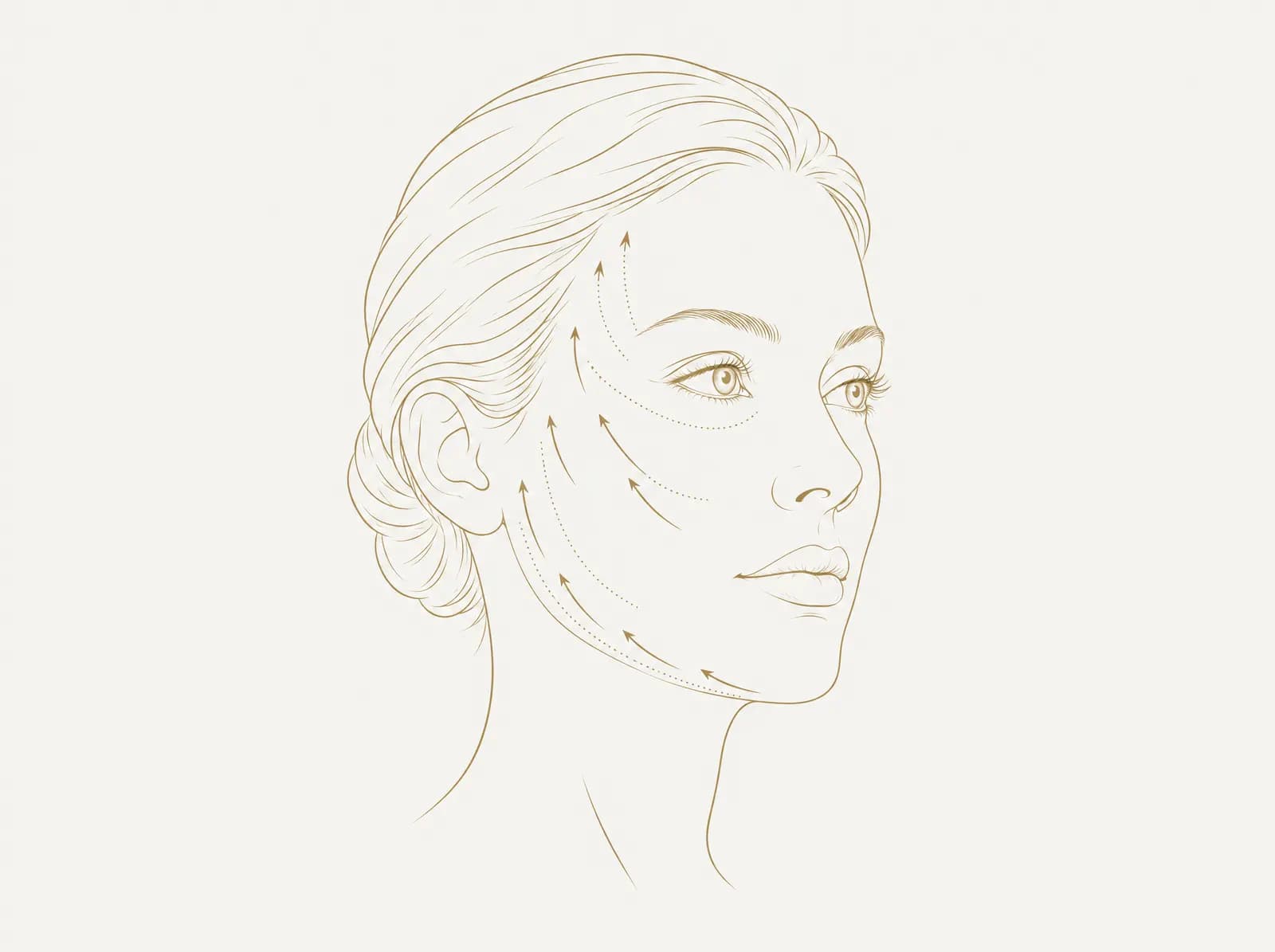
The clinic’s three drawings of the operation. How much is lifted, and in which direction, is planned for your own face.
Mini facelift

Step 1A small incision is made near the temple to reach the SMAS layer and the sagging skin, and both are lifted. 
Step 2The lifted tissue is fixed firmly in its new place. 
Step 3The incision is closed with fine stitches, which come out on day 5 to 7.
Step drawings taken from the clinic’s English mini lift page on 5 October 2026.
What is recovery like after a mini facelift?
- Days 1 to 3
- Swelling, tightness and some bruising are at their peak. For about a week, keep your head raised above your heart when you rest and sleep, and follow the clinic’s advice on swelling care.
- Days 5 to 7
- The temple stitches are removed; showering is fine from the following day. Bruising fades, and most people return to daily life at about one week.
- Weeks 2 to 4
- Remaining swelling and tightness ease. The skin near the incision may still feel numb or firm. Keep heavy makeup off the incision for about three weeks, as the clinic advises.
- Months 3 to 6
- The result has settled and the scar keeps fading.
How long should you stay in Seoul after a mini facelift?
Seven to ten days in Seoul is usually enough. Removal of the temple stitches falls on day 5 to 7, and the clinic sees you 2 to 3 times after surgery, so fix those dates with the clinic before booking flights. Most people fly around day 8. Mini facelift recovery carries on at home: swelling and tightness keep easing over the following weeks. Per the clinic’s aftercare notes, avoid drinking and smoking for at least a month, because they can delay healing and lead to infection, and wait about three weeks before strenuous exercise. If you become breathless, have chest pain, or one leg becomes painful and swollen, get emergency care first, then tell the clinic, and do not fly until a doctor says it is safe.
What are the risks of a mini facelift?
- Swelling, bruising and a tight feeling along the cheek and temple, which are expected and ease over the following weeks
- A hematoma, where blood pools under the lifted skin and may have to be drained. If one side swells quickly and becomes more painful, especially soon after surgery, contact the clinic straight away; if you cannot reach the clinic, get emergency care. If the swelling spreads into your neck or under your chin, or breathing or swallowing becomes difficult, get emergency care first, then tell the clinic
- Injury to a facial nerve branch, leaving part of the face numb or weak
- A visible or widened scar, or hair loss near the incision at the temple
- Asymmetry, or sagging that comes back sooner than you hoped and needs a further procedure
- Infection, poor wound healing, a blood clot in a vein or the general risks of anesthesia. Skin problems are more likely if you smoke
What affects the cost of a mini facelift in Korea?
Prices are not on this page yet; you receive a quote once the clinic has viewed your photos. The quote reflects the area to be lifted and anything added in the same session, such as under-eye fat repositioning, fat grafting or fillers. The written quote should name the surgeon and include the anesthesia, the 2 to 3 follow-up visits and stitch removal.
Cases from the clinic
Before and after photos from Urban Plastic Surgery, shown with the patient’s consent, as the clinic provided them and resized for the web. Results differ from person to person, and the risks above apply to every case.
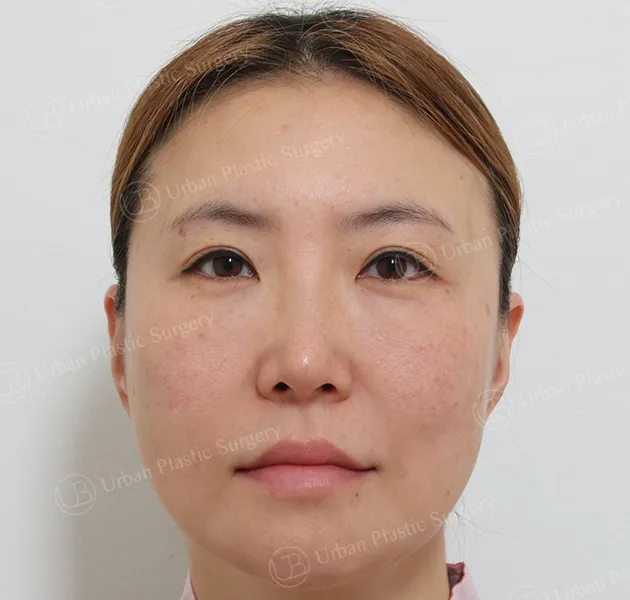
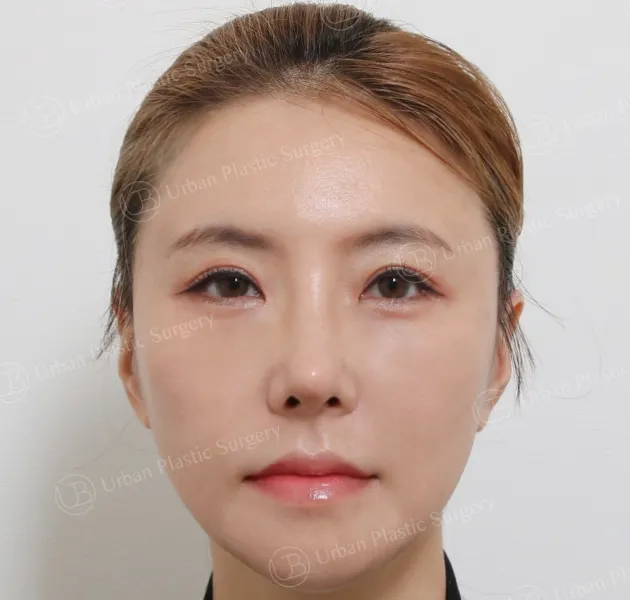
Mini facelift
Combined with Under-eye fat repositioning, Filler (forehead, smile lines)
Mini Face Lift + Transconjunctival Fat Repositioning / Filler (Forehead + Nasolabial Folds)
Urban Plastic Surgery
More questions
Who is a good candidate for a mini facelift?
At the clinic, this lift is usually for people in their 20s to 40s whose sagging is mainly in the lower face, such as the cheeks. If your mid face or neck has dropped a lot, the surgeon may suggest a full SMAS facelift instead.
How long does a mini facelift take?
About 1 hour under sedation or general anesthesia. You do not need a hospital stay, and stitches come out on day 5 to 7.
When can I fly home after a mini facelift?
Most people fly around day 8, after the stitch check. Expect the cheeks and temples to look a little swollen on the plane.
Is a mini facelift the same as a thread lift?
No. It is surgery: an incision is made, the SMAS layer is lifted and extra skin is removed. A thread lift places threads under the skin through needle holes, without an incision or skin removal. The change and the recovery are different, so ask the surgeon which one fits your face.
Related procedures
Guides and short answers
Sources
- Clinic figures as published by Urban Plastic Surgery, collected October 8, 2026. Your surgeon confirms your own plan.
- An uplifting experience: The ins and outs of mini facelifts. American Society of Plastic Surgeons
- Comparison of Deep SMAS Lift and MACS in Facelift: A Meta-Analysis. PubMed Central, US National Library of Medicine
- Facelift (rhytidectomy). NHS
Cases and clinic figures come from our partner clinic, Urban Plastic Surgery. The partnership does not change what we publish about risks and recovery.