GuidesFacelift & anti-aging
Surgical vs non-surgical facelift: which one fits your face?
Ultherapy, laser lifting and thread lifts, often called a non-surgical facelift, aim to tighten mildly loose skin with little downtime. The change is small; studies of microfocused ultrasound (Ultherapy) followed people for about a year. A facelift (SMAS or mini) lifts deeper tissue and removes skin, and SMAS results can last years. Surgery needs 7 to 14 days in Seoul.
What can non-surgical lifting do?
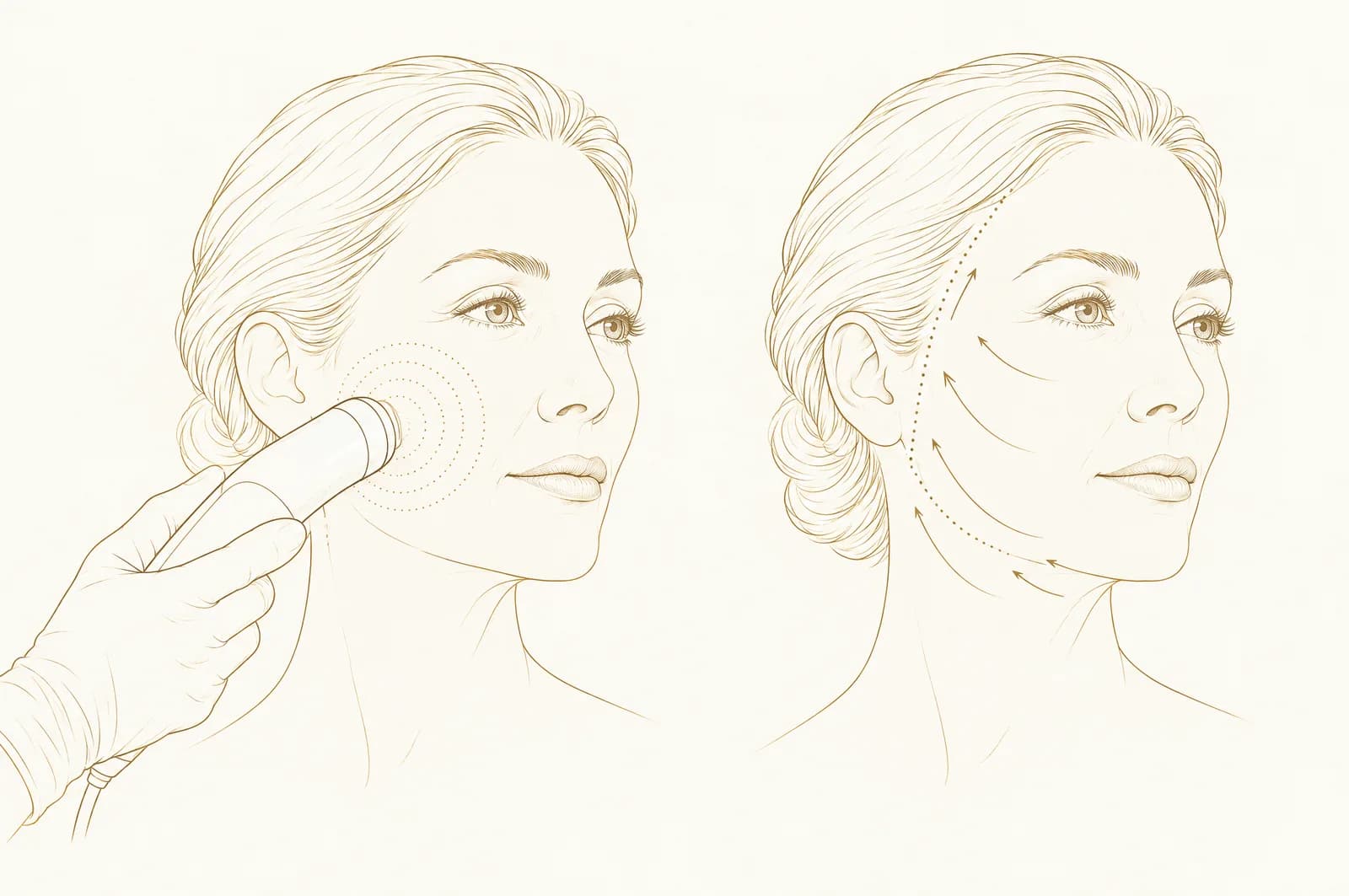
Non-surgical lifting uses heat from a device, or threads placed through needle holes, to tighten or lift the skin a little. It suits early looseness: a softer jawline, a slight drop at the brow or cheeks, and skin that has lost some firmness. No skin is removed, so the change stays modest.
At Urban Plastic Surgery, our partner clinic, the options fall into 3 groups. Fillers and skin boosters are listed next to them but do a different job.
- Ultherapy is a brand of microfocused ultrasound, often called HIFU. It heats points under the skin to tighten it. In the US, the FDA has cleared it to lift the eyebrow, to lift loose tissue under the chin and on the neck, and to improve lines on the chest. At the clinic a session takes under 30 minutes, with numbing cream or sedation.
- Laser lifting and radiofrequency devices deliver heat to the skin. What change to expect depends on the device and the number of sessions, so ask which device is used and what it usually changes. A session at the clinic takes 10 to 20 minutes, with numbing cream or none, and you can go back to your day straight away.
- A thread lift places threads with small barbs under the skin through needle holes to pull tissue up. At the clinic it takes about 30 minutes under local anesthesia and leaves no stitches to remove, and it is used on areas such as the cheeks, jaw and smile lines.
- Dermal fillers add volume, and skin boosters are used for skin quality. Neither lifts loose skin or deep tissue.
Where do devices and threads fall short?
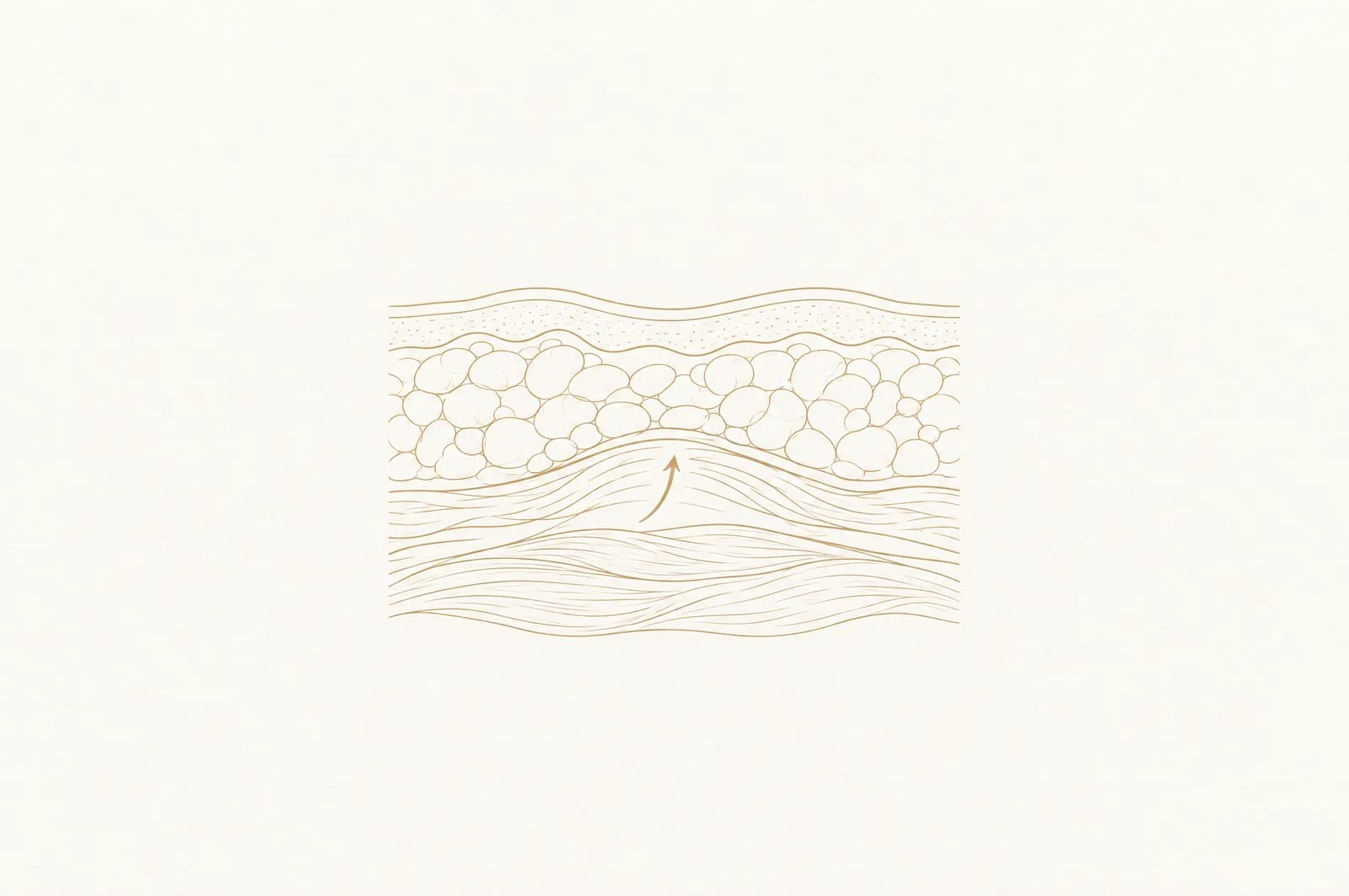
Devices and threads cannot remove skin. If skin hangs below the jawline, folds over at the neck or gathers in loose creases when you look down, heat will not take up that slack. They also cannot move the SMAS, the layer of muscle and connective tissue beneath the skin and fat, back to where it sat. That layer is what drops to form jowls and deep folds from the nose to the mouth.
The measured change is small. A systematic review of microfocused ultrasound found brow lifts of 0.47 to 1.7 mm across the studies it covered, and patients themselves rated the change as mild. That can be enough for early looseness, but it is too little for heavy sagging.
Threads carry their own side effects. A meta-analysis of 26 studies on facial thread lifting found swelling in 35% of patients and skin dimpling in 10%. Dimpling was more common in people over 50 (16% compared with 5.6%). Satisfaction was 98% just after treatment and fell to 88% at longer follow-up.
Which signs point to surgery?
Surgery is worth asking about when the looseness goes deeper than the skin. These signs usually mean a device or thread would change too little, or that the change would fade quickly:
- Jowls hang below the jawline and the jaw has lost its clear edge. An SMAS facelift covers the neck as well as the mid and lower face in one operation, and the clinic usually suggests it for people aged 50 and over.
- Sagging sits mainly in the cheeks and lower face, with early folds around the mouth. A mini facelift lifts skin and the SMAS through a shorter incision near the temple. The clinic usually suggests it for people in their 20s to 40s.
- Your brows sit low and push the upper eyelid skin down. An endoscopic brow lift raises the brow through short cuts inside the hairline.
- Your neck skin is loose or the neck has lines and bands. A neck lift treats this. At the clinic it takes about 1 to 2 hours under general anesthesia, and stitches come out after about 1 week. If the fullness is mostly fat under the chin, double chin surgery may be the closer match.
- You have had several device or thread treatments and each one seems to change less. That is a good moment to ask a surgeon what surgery would and would not change.
How do the options compare?
Times and anesthesia come from the clinic, and days in Seoul follow our procedure pages. The last column draws on the studies listed at the end of this guide; where no study gives a figure, it tells you what to ask.
Surgery also brings risks that devices and threads do not. Blood can pool under the skin (a hematoma) and may need draining soon after the operation. An injured facial nerve can leave part of the face numb or weak. Scars around the ear or temple can be visible or thick, hair near the incisions can thin for a while or for good, and anesthesia carries its own risks. The SMAS facelift and mini facelift pages list every risk, including infection and poor healing, which smoking makes more likely.
| Option | What it changes | Time and anesthesia | Visible downtime | Days in Seoul | How long it lasts |
|---|---|---|---|---|---|
| Ultherapy | Mild tightening of skin and the layer under it | Under 30 minutes, numbing cream or sedation | Redness and some swelling that pass | Fits a short stay. Leave a few days before flying | Studies follow people for about 1 year |
| Laser lifting | Heats the skin; ask what change to expect | 10 to 20 minutes, numbing cream or none | Daily life right away | Fits a short stay. Leave a few days before flying | Ask how many sessions are planned |
| Thread lift | A small lift of cheeks and jaw | About 30 minutes, local anesthesia | Swelling in about a third of patients, dimpling possible | Fits a short stay, no stitches to remove | Fades over time, satisfaction drops at longer follow-up |
| Mini facelift | Lifts skin and SMAS in the lower face, removes some skin | About 1 hour, sedation | About 1 week to daily life | 7 to 10 days | Ask the surgeon about your case |
| SMAS facelift | Lifts the mid face, lower face and neck, removes skin | About 2 to 3 hours, general anesthesia | 1 to 2 weeks to daily life | 10 to 14 days | Years, while aging continues |
| Endoscopic brow lift | Raises low brows and softens forehead lines | Sedation | Swelling and bruising, stitches out on day 5 to 7 | 7 to 10 days | Ask the surgeon about your brows |
How long does a facelift last, compared with devices and threads?
No lift stops aging. Treatments differ in how much they change at the start and how quickly aging catches up. Be wary of any single number for how long a treatment lasts. Published evidence is thinner for devices and threads than for surgery.
For microfocused ultrasound, the studies in the systematic review followed people for about 1 year, so there is little evidence on how the effect holds after that. For thread lifts, the drop in satisfaction at longer follow-up, described above, suggests the lift fades as time passes.
Facelift studies follow people for longer. In a study of 50 facelift patients, reported by the American Society of Plastic Surgeons, about 3 in 4 still looked younger than before surgery an average of 5.5 years later. The jaw held up better than the neck: jowl height lost about 20% of its improvement, and the angle between chin and neck lost about 70%. In another group of patients who later had a second facelift, the first one had lasted an average of 9 years.
How much recovery and time in Seoul does each need?
Non-surgical lifting fits into a short stay. The clinic lists no hospital stay, no stitches and no follow-up visit for Ultherapy, laser lifting or a thread lift. Leave a few days before your flight in any case, so redness, swelling or a bruise can settle and you can be checked if something feels wrong. Our guide to skin treatments with little downtime covers timing and flying in more detail.
Surgery needs a planned stay. These figures match our procedure pages:
- Mini facelift: about 1 hour under sedation, stitches out on day 5 to 7, daily life in about a week. Plan 7 to 10 days in Seoul. Most people fly around day 8, after the stitch check.
- SMAS facelift: about 2 to 3 hours under general anesthesia, stitches out on day 7 to 10, daily life in 1 to 2 weeks. Plan 10 to 14 days in Seoul. Most people fly around day 11.
- Endoscopic brow lift: sedation, stitches out on day 5 to 7. Plan 7 to 10 days in Seoul. Most people fly around day 7 or 8.
- Fix follow-up dates with the clinic before you book flights. Our surgery trip timeline walks through the weeks before and after.
Can you combine surgery and non-surgical treatments?
Yes, and many plans do. A facelift lifts and removes skin, but it does not add volume or change skin texture. Surgeons often pair it with other treatments for that reason. In the partner clinic’s published cases, a facelift has been paired with a neck lift, a forehead lift, lower eyelid surgery or liposuction under the chin. A mini facelift can be combined with under-eye fat repositioning, facial fat grafting or fillers.
Non-surgical treatments can also come before or after surgery. Some people start with a device and move to surgery when the change gets too small. Others use one later to help keep the skin firm. Either way, tell the surgeon about every filler, thread and device treatment you have had, with dates, and ask how long to wait after surgery before any treatment on the face. The skin and non-surgical treatments page lists what the clinic offers.
How do you decide what fits your face?
Start with what you see, then match it to what you can give in time and recovery. These steps help you arrive at a consultation with a clear question:
- Take photos in daylight from the front, both sides and at an angle, with your face relaxed and your hair back.
- Note where the looseness sits: brow, eyelids, cheeks, jawline or neck. Looseness in several areas at once is a reason to ask about surgery.
- Pinch the skin along your jaw and neck. If the skin is mostly firm with a little slack, a device may be enough. Skin that folds or hangs suits surgery better.
- Decide how much downtime you can take and how many days you can spend in Seoul.
- Ask yourself how often you are willing to repeat a treatment, and compare that with a single operation.
- Send your photos for a free review. A patient coordinator answers first, then the surgeon at the partner clinic that fits your case reviews your photos and consults in depth. Whether a device, threads or a facelift fits you is for that surgeon to judge, because the coordinator is not a doctor. Start a consultation when you are ready, or look through facelift and anti-aging options first.
More questions
Ultherapy vs facelift: can Ultherapy replace surgery?
Not when skin is truly loose. Ultherapy tightens skin a little and suits early looseness. A facelift lifts the deeper layer and removes extra skin, which no device can do. If you are unsure, send photos and ask the surgeon which one fits the amount of looseness you have.
At what age should I think about a facelift instead of a device?
There is no fixed age. Your skin, bone structure and how much has dropped matter more than the number. At the partner clinic, the mini facelift is usually suggested for people in their 20s to 40s with lower face sagging, and the SMAS facelift for people in their 50s or older.
Does Ultherapy hurt?
It can: a systematic review called it moderately painful. To ease it, the partner clinic offers numbing cream or sedation. After sedation, rest for the day and do not travel alone.
Will a thread lift or filler get in the way of a facelift later?
It can change how the surgeon plans the operation, so tell them about every thread, filler and device treatment you have had, with dates. Bring product names if you have them. The surgeon may suggest waiting before surgery.
Thread lift vs facelift: is a thread lift a type of facelift?
No. A thread lift leaves skin in place and pulls tissue up a little through needle holes, and satisfaction in studies falls at longer follow-up. A facelift is surgery: an incision near the ear, a lift of the SMAS layer and removal of extra skin, with results measured in years. Recovery and cost differ a great deal too.
Procedures in this article
Sources
- Journal Report Finds Patients Still Look Younger Five Years After Facelift Surgery. American Society of Plastic Surgeons
- Secondary Facelift Achieves Good Results, Reports Plastic and Reconstructive Surgery. American Society of Plastic Surgeons
- A Systematic Review of the Efficacy of Microfocused Ultrasound for Facial Skin Tightening. PubMed Central, US National Library of Medicine
- A Meta-Analysis and Systematic Review of the Incidences of Complications Following Facial Thread-Lifting. PubMed, US National Library of Medicine
- Ulthera System 510(k) premarket notification K180623. US Food and Drug Administration
- Facelift (rhytidectomy). NHS