GuidesEyes
Double eyelid shapes: tapered, in-out or parallel, and which suits your eyes
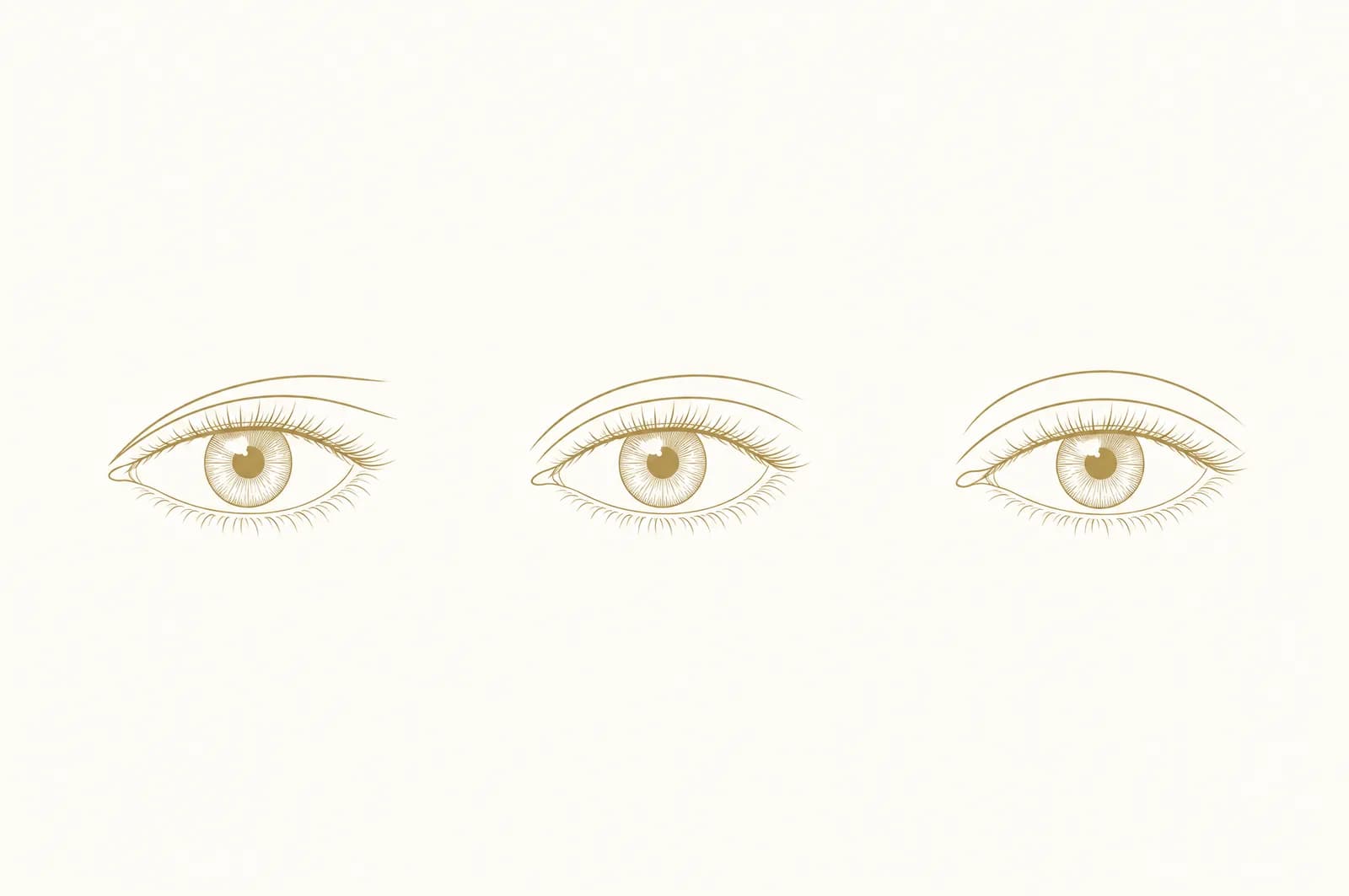
Double eyelid shapes come in 3 main types. A tapered crease joins the inner corner and widens outward, an in-out crease begins inside the inner corner fold and then rises above it, and a parallel crease runs at an even height. Which suits you depends on your inner corner fold, eyelid skin, eye opening and crease height.
What are the 3 double eyelid shapes?
Surgeons describe a crease by two things: where its inner end sits, and how its width changes across the lid. Korean clinics call the shapes in-line, in-out and out-line, while English-speaking surgeons mostly say tapered, in-out and parallel crease. Both sets of names describe the same lines.
A tapered crease (the in-line in Korean clinics) joins the fold at the inner corner of the eye. It is narrow near your nose and widens toward the outer corner, so with your eyes open it can look like a low, partly hidden line. A parallel crease (the out-line) starts above the inner corner fold and keeps about the same distance from the lashes all the way across. The in-out crease sits between the two. It begins inside the fold and then rises above it, so most of the line shows while the inner corner stays soft.
Tapered and parallel creases are both common. In one surgeon’s published series of 362 eyelid operations, 65% had a parallel crease and 35% a crease that joins the inner corner. Neither shape is more correct, and the right one depends on how the line sits on your own lid.
| Shape | Name in Korean clinics | Inner end | How it looks | Often chosen for |
|---|---|---|---|---|
| Tapered crease | In-line | Joins the inner corner fold | Low and soft, narrow near the nose, wider at the outer corner | A subtle change on eyes with an inner corner fold |
| In-out crease | In-out | Starts inside the fold, then rises above it | Visible along most of the lid, still soft at the inner corner | A clearer line without surgery on the inner corner |
| Parallel crease | Out-line | Starts above the fold | An even band of lid from end to end, the most defined look | Little or no inner corner fold, or a fold corrected with epicanthoplasty |
Tapered vs parallel: which shape suits your eyes?
Surgeons look at a handful of things before they suggest a shape. None of them is a fixed rule, and two people who ask for the same line can leave with different plans.
Urban Plastic Surgery, our partner clinic, suggests each line for a different eye on its double eyelid pages: the in-line for people who want little change, the in-out for a natural line that still shows, and the out-line for eyes without an inner corner fold that are set a moderate distance apart.
Your eye shape counts as well. How much lid shows when your eyes are open, how far apart your eyes are and whether one lid sits lower than the other all change how a line will look on you. That is why the shape is tried on your own eyelid at consultation instead of being picked from a chart.
| What the surgeon checks | Leans toward a tapered or in-out crease | Leans toward a parallel crease |
|---|---|---|
| Inner corner fold | A fold that covers the inner corner | No fold, or only a small one |
| Eyelid skin and fat | Fuller lids, where a high fold can look heavy | Thin lids with little fat |
| Crease height | A low crease | A moderate height, high enough to clear the fold |
| Change you want | A look close to your own eyes | A clearly visible, defined line |
How does the inner corner fold change the choice?
The epicanthal fold is the small fold of skin that covers the inner corner of many East Asian eyes. It decides where a crease can start. Surgeons call a crease an infold when it starts inside the fold, an onfold when it starts right on it and an outfold when it sits above it.
With a fold in place, most surgeons start the crease inside it, which gives a tapered or in-out line. A parallel crease placed above a strong fold tends to leave the inner part of the line hidden or broken, so the fold is often corrected at the same time with epicanthoplasty, also called inner eye corner surgery. Published reviews of Asian eyelid surgery describe the same pairing when a parallel crease is the goal.
Epicanthoplasty is a separate decision with its own trade-offs. It changes the inner corner itself and can leave a scar there, and if the result disappoints, restoring the corner takes another operation. If you like your inner corner as it is, a tapered or in-out crease lets you keep it. If you do want the corner opened, the partner clinic does it in 30 minutes to 1 hour under sedation, and those stitches are removed 5 to 7 days later.
How high should the crease be?
Height and shape are separate choices, but they pull on each other. A parallel crease has to sit high enough to clear the inner corner fold, so it is usually the highest of the 3. A tapered crease can be very low and still show at the outer corner.
A very high parallel crease is the shape most likely to look heavy. The higher the crease, the more lid shows below it and the more skin sits above it. On a fuller lid that skin rolls over the crease and can look thick and puffy, sometimes called sausage eyes. A Western-style high crease often looks unnatural on an East Asian eyelid for the same reason.
How strongly your eye opens matters as much as the line. If the lid sits low over the iris, a crease alone can make the eye look heavier. In that case surgeons often add ptosis correction, which tightens the lifting muscle so the lid opens further and the crease can stay at a moderate height.
Does the shape decide the method?
Partly. Your eyelid and the shape you want together steer the surgeon toward a method. The double eyelid surgery page covers each method in detail, and each one suits some shapes better than others.
- Non-incisional (suture) method: buried stitches, placed through a few tiny openings rather than a cut along the lid, fold the skin into a crease. It suits thin lids with little fat and a low to moderate crease, most often tapered or in-out. At the partner clinic the stitching takes 30 minutes to 1 hour, and daily life usually resumes within 5 to 7 days. A suture crease can loosen over the years, more often on thicker lids.
- Incisional method: a cut along the planned crease lets the surgeon remove extra skin and fat and fix the crease inside. It suits fuller lids, extra skin and a crease that has come loose before, and it is used for many parallel creases. Stitches come out on day 5 to 7.
- Natural adhesion method: a buried-stitch technique, offered at the partner clinic, for eyes that open weakly. It tightens the lifting muscle and sets the crease in one step. It suits thin lids with a mild to moderate droop. A stronger droop or more fat usually needs an incisional approach.
- Loose skin from aging: when skin hanging over the lashes is the main problem, upper blepharoplasty removes it through a cut in the crease so the line shows again.
What if your crease ends up too high?
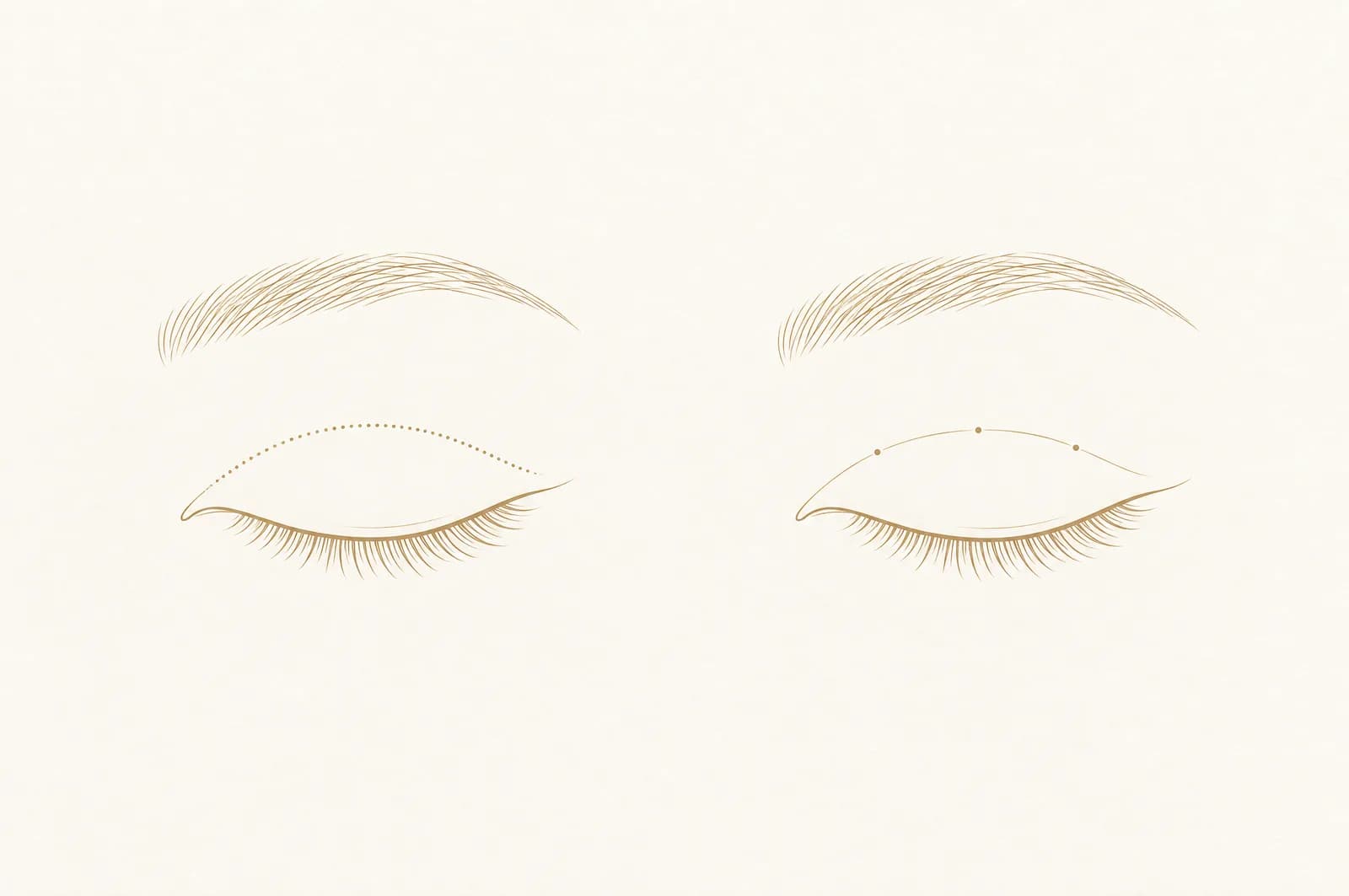
First, give it time. For the first few weeks the crease looks higher and thicker than it will end up, because swelling lifts and fills the lid. The line softens over 1 to 3 months, and the result is usually judged at about 3 months.
If it is still too high after that, it can often be lowered. In revision double eyelid surgery the surgeon reopens the high line, frees the scar that holds it and sets a new crease further down, sometimes tucking fat or soft tissue between the layers to stop the old line from returning. How far it can come down depends on how much skin is left and how much scar there is. Most surgeons wait several months after the first surgery before operating again.
The other common reasons for a revision are a crease that is too low, uneven, doubled or faded, a thick line and a visible scar. A crease revision at the partner clinic is about a 1-hour operation under sedation or local anesthesia; its stitches are removed on day 7, so allow 7 to 10 days in Seoul. The revision surgery planning guide lists the records and photos to bring.
How do you show the surgeon the crease you want?
Words such as “natural” or “defined” mean different things to different people, so show the surgeon what you mean instead of describing it. These steps make the consultation more precise.
- Take clear photos of your own eyes in daylight without makeup: straight on with your eyes open, with them closed, and looking down.
- Collect 2 or 3 photos of creases you like, ideally on eyes shaped like yours, and 1 you do not like. Say which part you like: the inner end, the height or the thickness of the fold.
- Look at the clinic’s real before-and-after cases for eyes like yours, and ask which crease shape each one has.
- Ask the surgeon to simulate the crease. A thin, blunt rod or probe, which some clinics call a bougie, is pressed gently against your lid in front of a mirror, so you can see a temporary fold at different heights and shapes before anything is marked.
- Ask whether you also need ptosis correction or epicanthoplasty, which method the surgeon suggests for your lid, and why.
- Check both eyes together. Most people have a small difference between the two lids, and the plan should say how it is handled.
Can you plan the shape before you fly to Seoul?
You can start with photos. Through our free consultation, a patient coordinator answers first and passes your photos to the partner clinic that fits your plan, where the surgeon reviews them and talks you through the crease in depth. Crease height, shape and method are medical calls, so they rest with the surgeon and not with the coordinator, who is not a doctor. You pay nothing for the consultation or the clinic matching; the eyelid surgery itself is billed at the clinic’s own price.
The final shape is still agreed in person, after the surgeon has examined your lids and simulated the line. Plan 5 to 7 days in Seoul for a first double eyelid surgery, and longer if ptosis correction or epicanthoplasty is added. Before you commit to a clinic, the guide on choosing a plastic surgery clinic sets out what to compare, and the eye surgery page lists every option.
More questions
Which double eyelid shape looks the most natural?
On East Asian eyes with an inner corner fold, a low tapered or in-out crease usually looks closest to a crease people are born with, because it follows the fold instead of crossing it. Natural is personal, though. On an eye with little or no fold, a parallel crease at a moderate height can look just as natural.
Is an in-line crease the same as a tapered crease?
Yes. In-line is the name Korean clinics use for a tapered crease, the shape that joins the inner corner fold. Out-line is their name for a parallel crease, and in-out is used for the shape in between. Using both names at consultation avoids confusion.
Do I need epicanthoplasty to get a parallel crease?
Not always. With little or no inner corner fold, a parallel crease can start above the inner corner, and the corner stays as it is. With a strong fold, the inner part of a parallel line tends to disappear under it, which is why the two are often planned together. The surgeon decides after examining your inner corner.
Can the suture method make a parallel crease?
On thin lids with little fat and a moderate height, often yes. On fuller lids or with a high line, buried stitches carry more weight and are more likely to loosen over time, so the incisional method is the usual choice. Ask which method fits your lid and the shape together.
Can I switch from a tapered to a parallel crease later?
Usually, through a revision. The crease is reset at a new shape and height, and with a strong inner corner fold epicanthoplasty may be added. It is another operation with its own swelling and stitch check, so it is worth choosing the first shape with care.
Procedures in this article
Sources
- The Asian Eyelid: Relevant Anatomy. PubMed Central, US National Library of Medicine
- Techniques, Principles and Benchmarks in Asian Blepharoplasty. PubMed Central, US National Library of Medicine
- Reconsideration of the Epicanthus: Evolution of the Eyelid and the Devolutional Concept of Asian Blepharoplasty. PubMed Central, US National Library of Medicine
- Epicanthoplasty. EyeWiki, American Academy of Ophthalmology
- Revision Upper Blepharoplasty. PubMed Central, US National Library of Medicine