GuidesBreast
Choosing breast implants: brand, size, shape and placement
Choosing breast implants comes down to 4 decisions you make with your surgeon: brand and surface, size, shape (round or teardrop) and placement over the muscle, under it or in a dual plane pocket. Our partner clinic offers Motiva, Mentor and Sebbin. Your chest width, skin stretch and tissue cover guide each choice more than a cup size does.
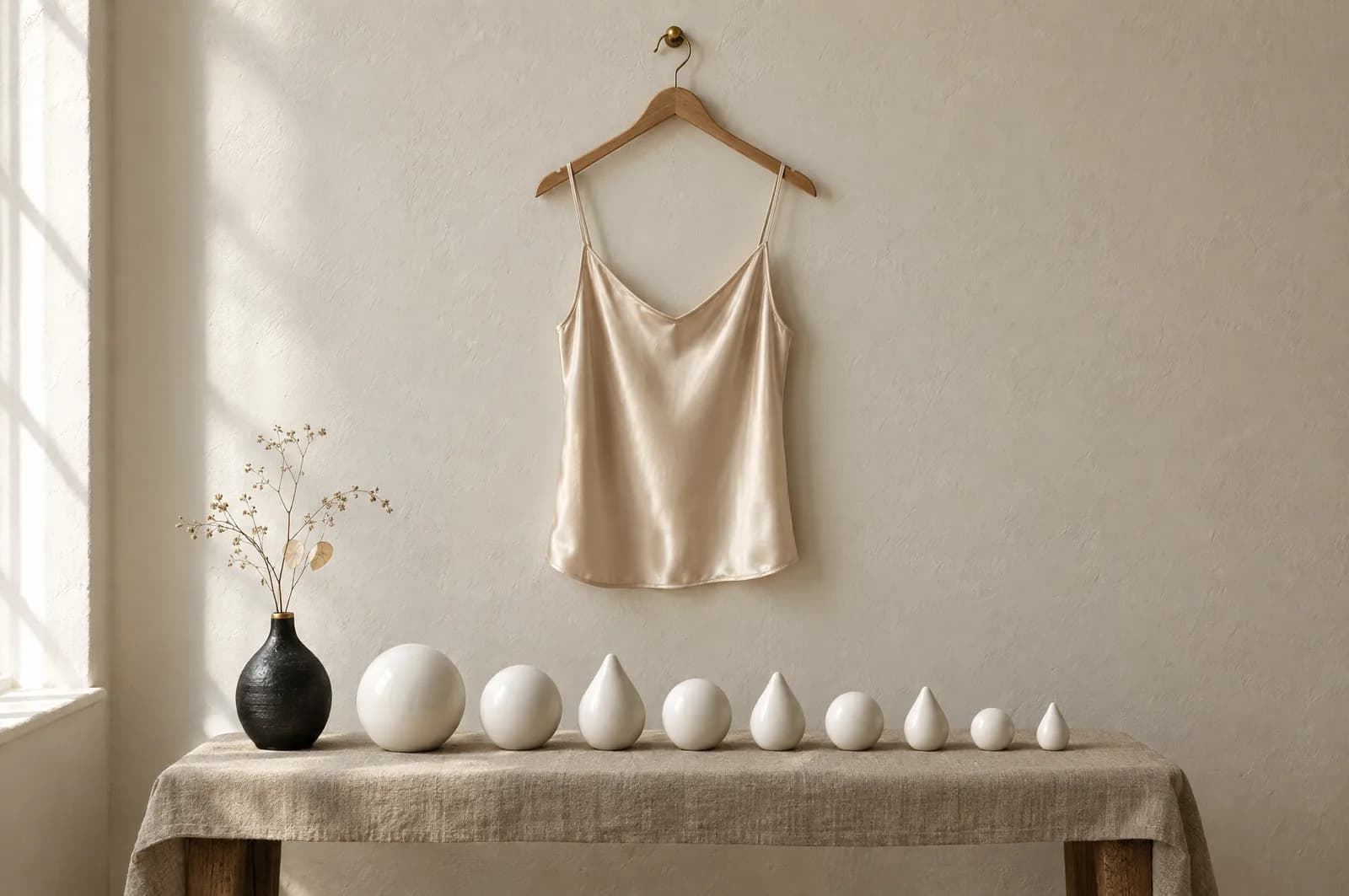
What do you decide when you choose a breast implant?
Every implant plan settles the same 4 things: the brand and surface (down to the exact model), the size, the shape, and where the implant sits in relation to the chest muscle. The incision is a separate choice that mostly decides where your scar lies. The operation itself, from surgery time to recovery, is on the breast augmentation page.
The decisions depend on each other. A larger implant needs enough skin and tissue to cover it, and thin tissue may lead the surgeon to place the implant under the muscle. That is why they are settled together at an exam, after the surgeon has measured you.
| Decision | Usual options | What mostly guides it |
|---|---|---|
| Brand and model | Motiva, Mentor or Sebbin at the partner clinic | Your tissue, the shape and size you want, the models on offer |
| Surface | Smooth or textured shell | The model and shape, and a rare cancer risk seen mostly with textured shells |
| Size | A volume in cc, chosen after measuring | Chest width, skin stretch and tissue cover |
| Shape | Round implant or teardrop implant | How much upper breast fullness you want, tissue cover |
| Placement | Over the muscle, under the muscle or dual plane | Tissue thickness, your activities, the surgeon’s exam |
| Incision | Breast fold, armpit or around the areola | Where you prefer the scar, implant size and type |
Which implant brands are used, and does the surface matter?
Urban Plastic Surgery, our partner clinic, offers 3 brands of silicone gel implant: Motiva, Mentor and Sebbin. It lists the same surgery time and recovery for all 3. Each brand makes several models that differ in shape, surface, profile and size, so ask for the exact model, not only the brand. If Motiva is on your list, the Motiva breast implants page sets out which of its models the US FDA has approved.
A silicone gel implant has a silicone outer shell filled with silicone gel. In the United States, the FDA approves silicone gel implants for breast augmentation from age 22. Shells come smooth or textured, and the surface is part of the model you choose.
Surface matters for one rare risk. Breast implant-associated anaplastic large cell lymphoma (BIA-ALCL) is a cancer of the immune system that can develop in the scar tissue and fluid around an implant. The FDA reports that most cases have involved textured implants, though cases with smooth implants have also been reported, and the rates are not well defined. Ask which surface your proposed model has. See a doctor if a breast swells, a lump appears or fluid collects around an implant, even years later.
How is the right breast implant size worked out?
Breast implant size is given in cc, the volume of the implant, but the number on its own says little. The same volume looks different on a narrow chest and a wide one, and cup sizes vary between bra makers and countries. Surgeons usually start from your body rather than from a target number.
No surgeon can promise a cup size from a cc number. Bring photos of shapes you like and ones you do not, and describe how you want clothes to fit, so the surgeon can tell you what your tissue can carry. These are the things they check:
- Chest and breast width. The width of the implant is usually matched to the width of your own breast.
- Skin stretch. Tight skin limits how much volume fits, and loose or sagging skin may call for a breast lift as well as, or instead of, an implant.
- Tissue cover. The thickness of skin, fat and breast tissue over the implant affects how much of its edge you may see or feel, and it feeds into the placement choice.
- Your own breasts. Differences between the two sides, where each nipple sits and the position of the breast fold all shape the plan.
- Your daily life. Sport, work that involves lifting and the clothes you like to wear are worth mentioning.
Should you choose a round implant or a teardrop implant?
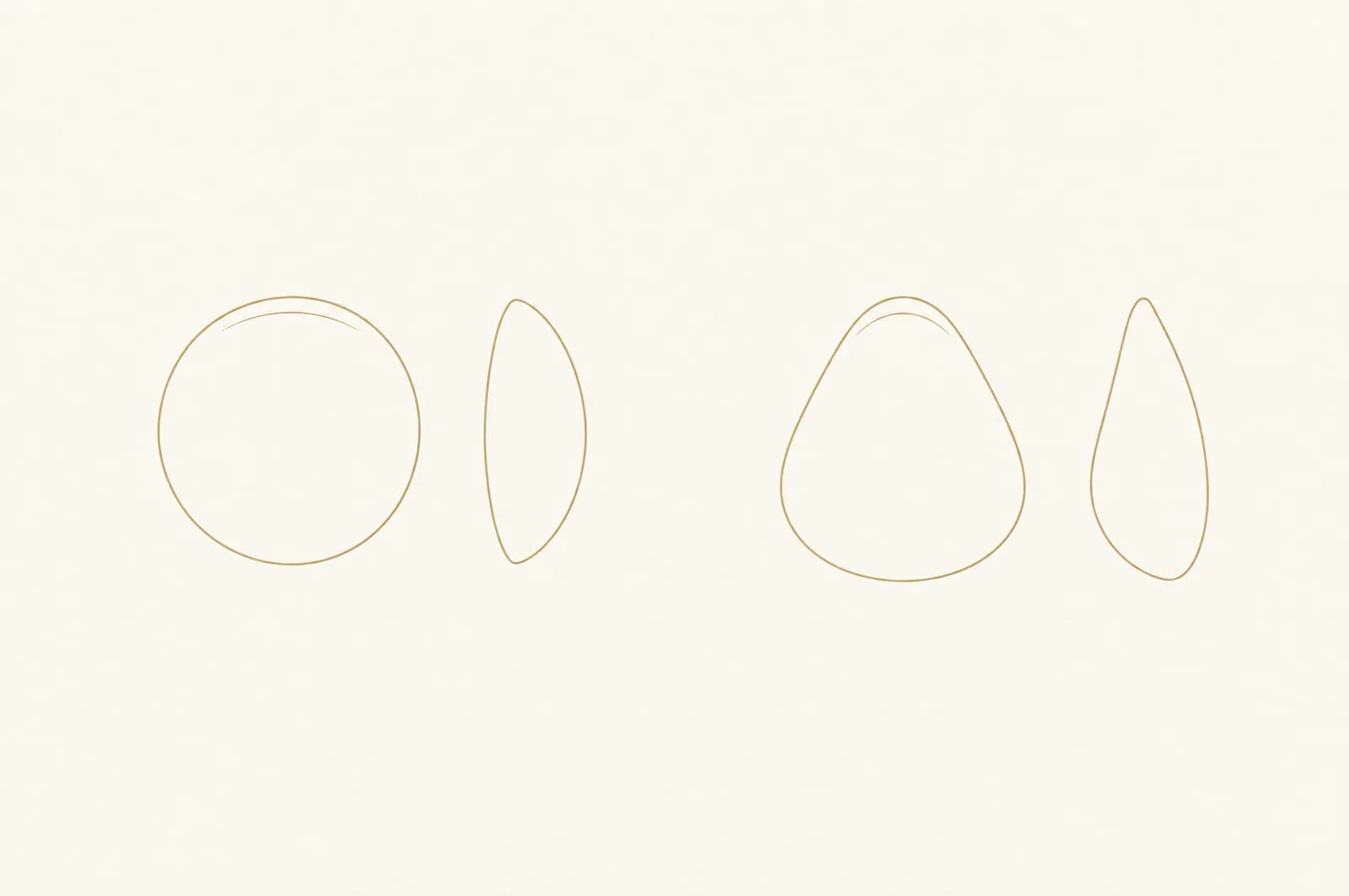
A round implant is the same shape all the way round, with its fullest point in the center. A teardrop implant, also called an anatomical or shaped implant, is fuller at the bottom and slopes toward the top, closer to the side profile of a breast.
Because a teardrop implant has a top and a bottom, the breast can change shape if it rotates inside its pocket. A round implant looks the same whichever way it turns. If you are offered a teardrop model, ask how the surgeon keeps it in position and which surface it has.
| Feature | Round implant | Teardrop implant |
|---|---|---|
| Shape | The same all the way round | Fuller at the bottom, sloping at the top |
| Upper breast | More fullness at the top | A gentler slope at the top |
| If it turns | The breast shape stays the same | The breast shape can change |
| Ask about | Profile (how far it projects) and width | How it stays in position, and its surface |
Over the muscle, under the muscle or dual plane?
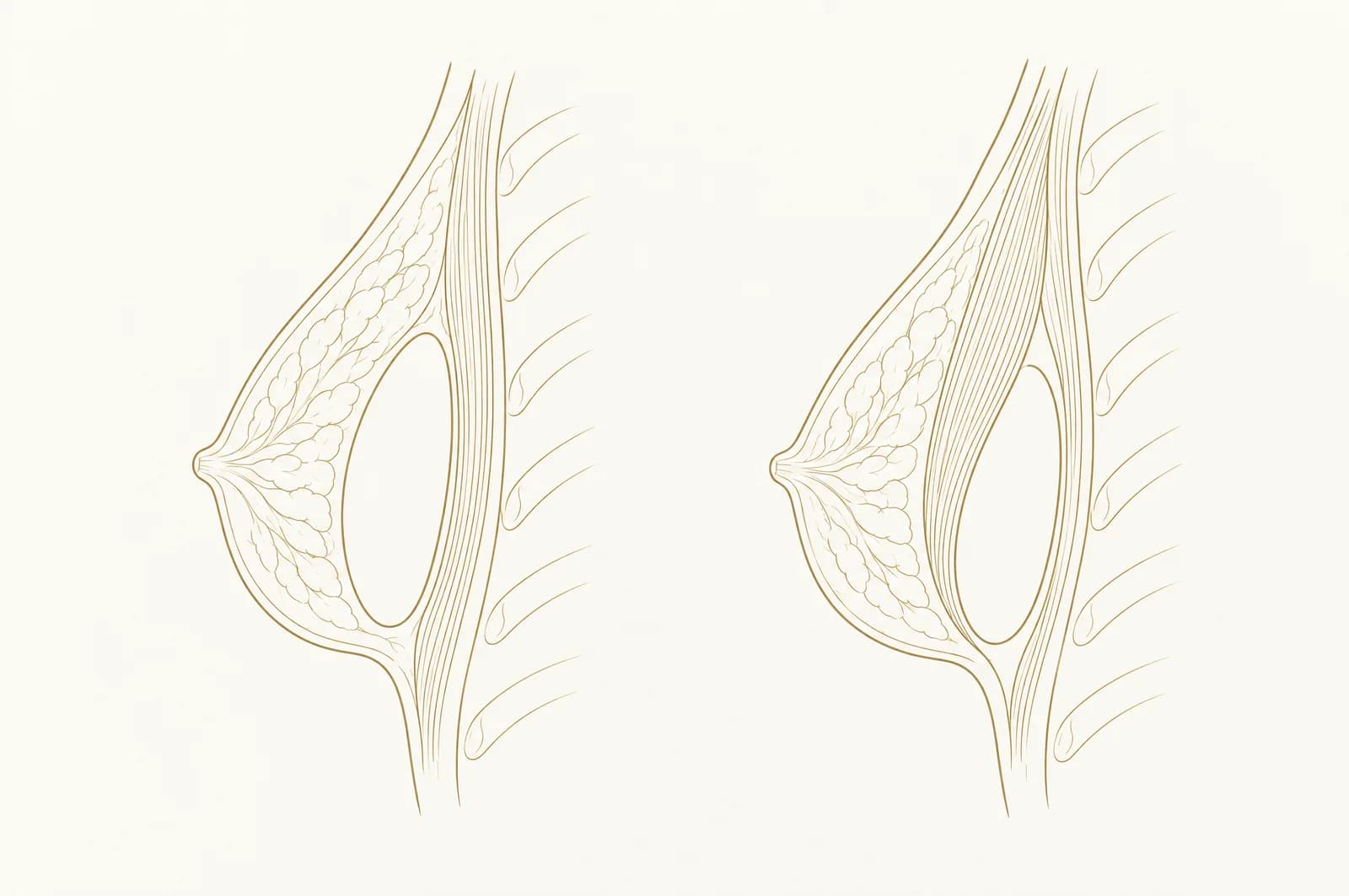
Placement describes where the implant sits in relation to the large chest muscle (pectoralis major). Over the muscle (subglandular) means the implant sits under the breast tissue, in front of the muscle. Under the muscle (submuscular) means it sits behind the muscle. Dual plane is a version of under the muscle: the upper part of the implant lies behind the muscle and the lower part lies under the breast tissue.
Which one suits you depends mostly on how much tissue you have. When skin and breast tissue are thin, the muscle adds a layer of cover over the upper part of the implant. When there is more tissue, over the muscle may be an option. Each placement has trade-offs in recovery and in how the breast moves when you tense your chest, so ask the surgeon to explain them for your body, and say if you lift weights or train often.
| Placement | Where the implant sits | What covers it | A question to ask |
|---|---|---|---|
| Over the muscle | Under the breast tissue, in front of the chest muscle | Skin, fat and breast tissue only | Is my tissue thick enough to cover the edge? |
| Under the muscle | Behind the chest muscle | Muscle, mostly over the upper part, plus breast tissue | How will recovery and chest movement feel? |
| Dual plane | Top part behind the muscle, lower part under the breast tissue | Muscle at the top, breast tissue at the bottom | Why do you suggest it for my shape? |
Where does the incision go?
The implant goes in through one of 3 common incisions: in the fold under the breast, in the armpit, or around the lower edge of the areola. The choice decides where your scar lies, and it can limit the size or type of implant that fits through it. The partner clinic’s published cases use the breast fold and armpit incisions.
If you already have implants and want a change, breast implant revision is planned as its own operation, often through the old scar. Other breast operations, such as a lift or a reduction, are listed under breast surgery.
How is the decision made at your consultation?
Much of the groundwork happens before you fly. Through our free consultation, a patient coordinator answers first and passes your photos to the partner clinic that fits your plan, where the surgeon later examines you in Seoul and settles brand, size, shape and placement with you. The coordinator is not a doctor and does not choose any of these. Clinic matching is free for you as well. A typical order looks like this:
- Before you travel, send clear photos and share your goals, height and weight, any earlier breast surgery and your health history. The surgery trip timeline shows how the days in Seoul fit together.
- In Seoul, the surgeon examines your chest, takes measurements and checks your skin and tissue.
- Urban Plastic Surgery lists 3D simulation in its breast planning, so you can see estimated sizes on an image of your own body. Treat it as a planning aid, not a picture of your result.
- You agree on brand, model, size, shape, surface, placement and incision, and ask for all of them in writing.
- On the day, the surgeon confirms the plan. The operation itself lasts up to 2 hours, under sedation or general anesthesia, and you rest at your hotel that night.
What records and checks do you need after surgery?
Breast implants are not lifetime devices. The longer you have them, the more likely you are to need them removed or replaced, for reasons such as capsular contracture, rupture or a change of mind. If that time comes, breast implant removal explains the options, and planning a revision covers which records to bring. Some people also report symptoms such as tiredness or joint pain that they link to their implants, and rare cancers other than BIA-ALCL have been reported in the scar tissue around implants; our breast augmentation page lists these with the other risks.
Silicone gel implants can rupture without symptoms, which is called a silent rupture. Current FDA advice for people without symptoms is an ultrasound or MRI 5 to 6 years after surgery, then every 2 to 3 years. If you have symptoms, or an ultrasound result is unclear, an MRI is advised. These checks happen at home, so plan who will do them.
Keep your implant record for as long as you have implants. FDA labeling for breast implants includes a patient device card that shows the style, size and serial or lot number of each implant. Ask the clinic for the same details in writing and keep a copy with your travel papers. Implant makers set their own warranty terms, so ask whether yours applies to surgery in Korea and how you would claim from abroad. Your record should show:
- Brand, model, size and surface of each implant
- Serial or lot number of each implant
- Placement and incision
- Date of surgery and the surgeon’s name
- Warranty details from the maker, and how to claim from abroad
More questions
Do teardrop implants look more natural than round implants?
Not always. Both can look natural when the size and placement suit your tissue. A teardrop implant gives a gentler slope at the top of the breast, and a round implant more fullness there. Which looks natural on you depends on your own breast shape and what you want. Ask the surgeon to show you both options for your body.
Is it better to put implants over or under the muscle?
Neither is right for everyone. Under the muscle adds cover when your tissue is thin. Over the muscle can suit people who have enough tissue to hide the implant edge. Dual plane sits between them. The surgeon recommends one after examining you, so ask why they suggest it for your body.
Can I choose the implant brand myself?
You can ask for a brand, and the surgeon tells you whether one of its models suits your tissue and goals. Bring the brand, model and size you have in mind to the in-person consultation, and expect the final choice to follow the exam. No brand removes the usual implant risks.
Should I choose a smooth or textured implant?
Your surgeon usually suggests a surface together with the model and shape, because the surface is part of the model. The FDA links most BIA-ALCL cases to textured implants, while some have involved smooth ones. Ask which surface your proposed model has, why it suits your plan and what follow-up the clinic advises.
Can I change my mind about implant size in Seoul?
Usually, yes, until the plan is final. The surgeon examines and measures you in Seoul before surgery, and size, shape and placement are agreed there. If you want a different size from the one discussed online, say so at the in-person consultation and ask for the updated plan in writing.
Procedures in this article
Sources
- Types of Breast Implants. US Food and Drug Administration
- Things to Consider Before Getting Breast Implants. US Food and Drug Administration
- Labeling for Approved Breast Implants. US Food and Drug Administration
- Questions and Answers about Breast Implant-Associated Anaplastic Large Cell Lymphoma (BIA-ALCL). US Food and Drug Administration
- Current State of Evidence-Based Long-Term Monitoring Protocols for Breast Plastic Surgery Patients. PubMed Central, US National Library of Medicine