Nose
Rhinoplasty in Korea
Rhinoplasty, or a nose job, reshapes the nose. Korean rhinoplasty often raises a low bridge and refines a wide or round tip with an implant, your own cartilage or both. Most plans take 1 to 2 hours under sedation, with no overnight stay. The splint comes off after about a week; plan 7 to 10 days in Seoul.
Who is a good candidate for rhinoplasty?
- Your nose bridge is low or flat and you want more height in profile
- Your tip looks wide, round or undefined and you want a slimmer shape
- Your nose has a small hump and you want a straighter profile, or it looks short and you want a little more length
- You are healthy and can take a week or more away from work and exercise
When it may not be the right choice
- Your main problem is breathing through your nose. A check of the septum and functional rhinoplasty may be the better first step
- You have had nose surgery before. Revision rhinoplasty is planned differently
- You smoke and cannot stop for the weeks before and after surgery
Which method fits you?
Most Korean rhinoplasty combines an implant or a cartilage graft to raise the bridge with work on the tip. The surgeon recommends a plan after checking your skin thickness, bridge height and tip support. The clinic also plans the look in one of two styles: a sharper, more defined profile, or a softer and more natural line.
| Method | What happens | Suits | Downtime |
|---|---|---|---|
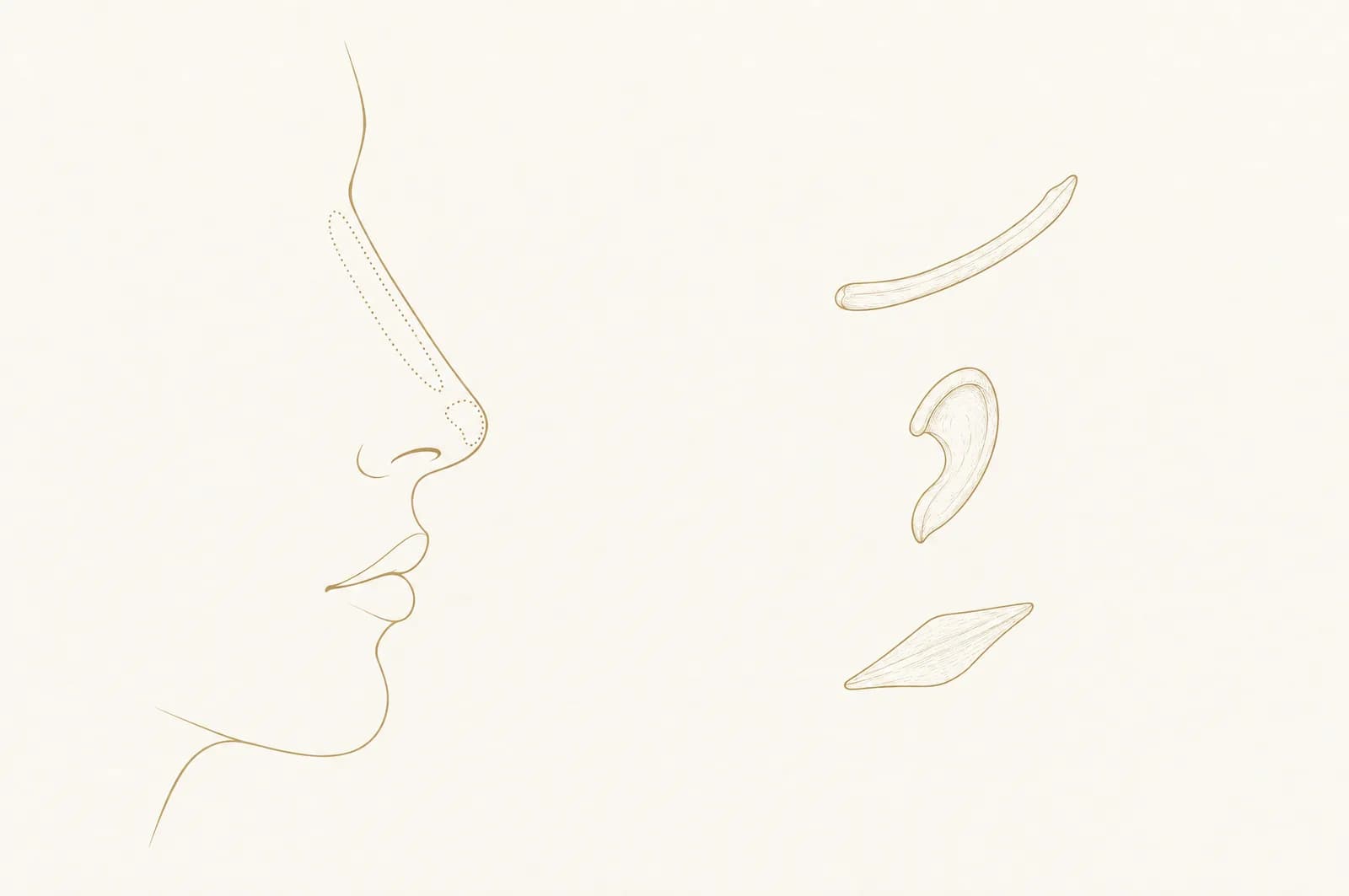
| Implant with cartilage at the tip | A soft implant, often silicone, raises the bridge. Cartilage, usually from the septum inside your nose, supports and shapes the tip. | A low bridge with skin thick enough to cover an implant | Splint and stitches out after about 1 week |
| Your own cartilage only | Cartilage from your septum, ear or rib builds the bridge and tip, with no implant. This takes about 2 hours under sedation or general anesthesia. | You want to avoid implants, have thin skin or need strong support | Stitches come out between day 7 and day 10, while any ear or chest wound heals alongside the nose |
| Tip or bone work without an implant | The tip cartilage is reshaped and supported. Bone can be cut to narrow a wide bridge or take down a hump. | Good bridge height with a wide, round or droopy tip, or a hump | Stitches out on day 5 to 10, about 7 to 10 days to recover |
What happens on the day of rhinoplasty?
- Consultation with the surgeon. Together you look at your face from the front and side and agree on bridge height, tip shape and the style you want.
- Sedation for most implant plans. When only your own cartilage is used, the clinic lists sedation or general anesthesia, so ask which applies to you.
- A small cut is made across the skin between the nostrils (open approach) or inside the nostrils. The bridge is raised and the tip is shaped. This takes about 1 to 2 hours.
- An outer splint is fixed over the bridge to protect the new shape. The clinic lists no overnight stay, so you leave for your hotel after a short rest; ask whether this changes if rib cartilage is taken.
What is recovery like after rhinoplasty?
- Days 1 to 3
- The splint is on and you breathe mostly through your mouth. Swelling and bruising around the eyes are at their peak. Sleep with your head raised.
- Around day 7
- The splint and stitches come out. The tip looks puffy and the nose feels stiff and numb. Bruising is fading.
- Weeks 2 to 3
- Bruising has largely faded and most people feel comfortable in public, though the tip is still swollen.
- Weeks 4 to 6
- You can usually go back to hard exercise if your surgeon agrees. Swelling keeps going down.
- Months 6 to 12
- The shape becomes more defined. The tip keeps refining for up to a year.
How long should you stay in Seoul after rhinoplasty?
Give yourself 7 to 10 days in Seoul. With an implant plan the splint and stitches come off together at the day 7 check, so most people book their flight for around day 8. If your plan uses only your own cartilage, or works on the tip or bone without an implant, stitches can stay in until day 10, so aim for the longer end. Do not blow your nose, and hold off on alcohol, saunas and swimming in the first weeks. Ask the surgeon when glasses can rest on your nose again. As after any operation, if you become breathless or have chest pain, get emergency care first, then tell the clinic. If rib cartilage is used, soreness at the chest wound that eases day by day is expected, but chest pain that comes on suddenly or gets worse needs emergency care first, then a call to the clinic. Do the same if your nose bleeds heavily and does not stop.
What are the risks of rhinoplasty?
- Swelling, bruising and a stiff, numb tip, which are expected and settle over weeks to months
- A blocked nose for the first week or so. Rarely, breathing stays harder than before surgery
- Nosebleeds, usually light and in the first few days. Heavy bleeding that does not stop needs emergency care
- Infection, which with an implant can mean the implant has to come out
- With rib cartilage: chest pain and a scar where it is taken, and rarely air around the lung (pneumothorax)
- An implant that shifts, shows through thin skin, presses on the tip skin or is pulled by scar tissue
- Asymmetry or a shape you are not happy with, which may need revision surgery
- Rarely, a hole in the septum or a change in your sense of smell
What affects the cost of rhinoplasty in Korea?
No rhinoplasty price appears here yet, since the clinic quotes only after it has seen your photos. The quote depends on the material (an implant, septal, ear or rib cartilage, or a mix), how many parts of the nose change, whether bone is cut and any other surgery on the same day. A complete written quote names the surgeon and the implant or cartilage source, and covers anesthesia, follow-ups, the splint and stitch removal.
More questions
How long does rhinoplasty take in Korea?
Most plans take about 1 to 2 hours at the clinic, under sedation. A plan built only from your own cartilage takes about 2 hours, under sedation or general anesthesia. Either way the clinic lists no overnight stay, but if rib cartilage is taken, ask whether you should stay the night.
Should I choose an implant or my own cartilage?
It depends on your skin, how much height you want and whether you have had surgery before. An implant is quick to place and can be removed, but it can shift, show through thin skin or become infected. Your own cartilage avoids a foreign material but needs a donor site. Many plans use both: an implant for the bridge and septal cartilage for the tip.
When can I fly home after rhinoplasty?
With an implant plan, most people fly around day 8, after the splint and stitches come out. If only your own cartilage is used, stitches can stay in until day 10, so expect to fly a little later. A blocked, swollen nose on the plane is common in the first weeks.
When will I see the final shape of my nose?
The final shape can take up to a year. Most bruising fades within 2 to 3 weeks, while the tip stays swollen for longer and keeps refining over that year.
Can I choose a more defined or a more natural look with rhinoplasty?
Yes. The clinic plans rhinoplasty in two styles: a sharper, more defined profile, or a softer line that blends with your face. Your skin thickness and tip support set the limits for either, so bring photos of noses you like and ask what is realistic for you.
Related procedures
Sources
- Clinic figures as published by Urban Plastic Surgery, collected October 3, 2026. Your surgeon confirms your own plan.
- Rhinoplasty Risks and Safety. American Society of Plastic Surgeons
- Rhinoplasty Recovery. American Society of Plastic Surgeons
- Nose reshaping (rhinoplasty). NHS
- Current Update in Asian Rhinoplasty. PubMed Central, US National Library of Medicine
- Complications associated with autologous rib cartilage use in rhinoplasty: a meta-analysis. PubMed, US National Library of Medicine
Cases and clinic figures come from our partner clinic, Urban Plastic Surgery. The partnership does not change what we publish about risks and recovery.