GuidesNose
Silicone, Gore-Tex or rib cartilage? How rhinoplasty materials compare
Rhinoplasty materials come in two groups: implants (silicone, 3D custom silicone, Gore-Tex) and tissue (your septal, ear or rib cartilage, donor rib, dermis or fascia). Implants are quicker to place but can shift, show or become infected, and silicone is the simplest to remove. Your own tissue rarely becomes infected but needs a donor site, and rib cartilage can warp.
What materials can shape the bridge and the tip?
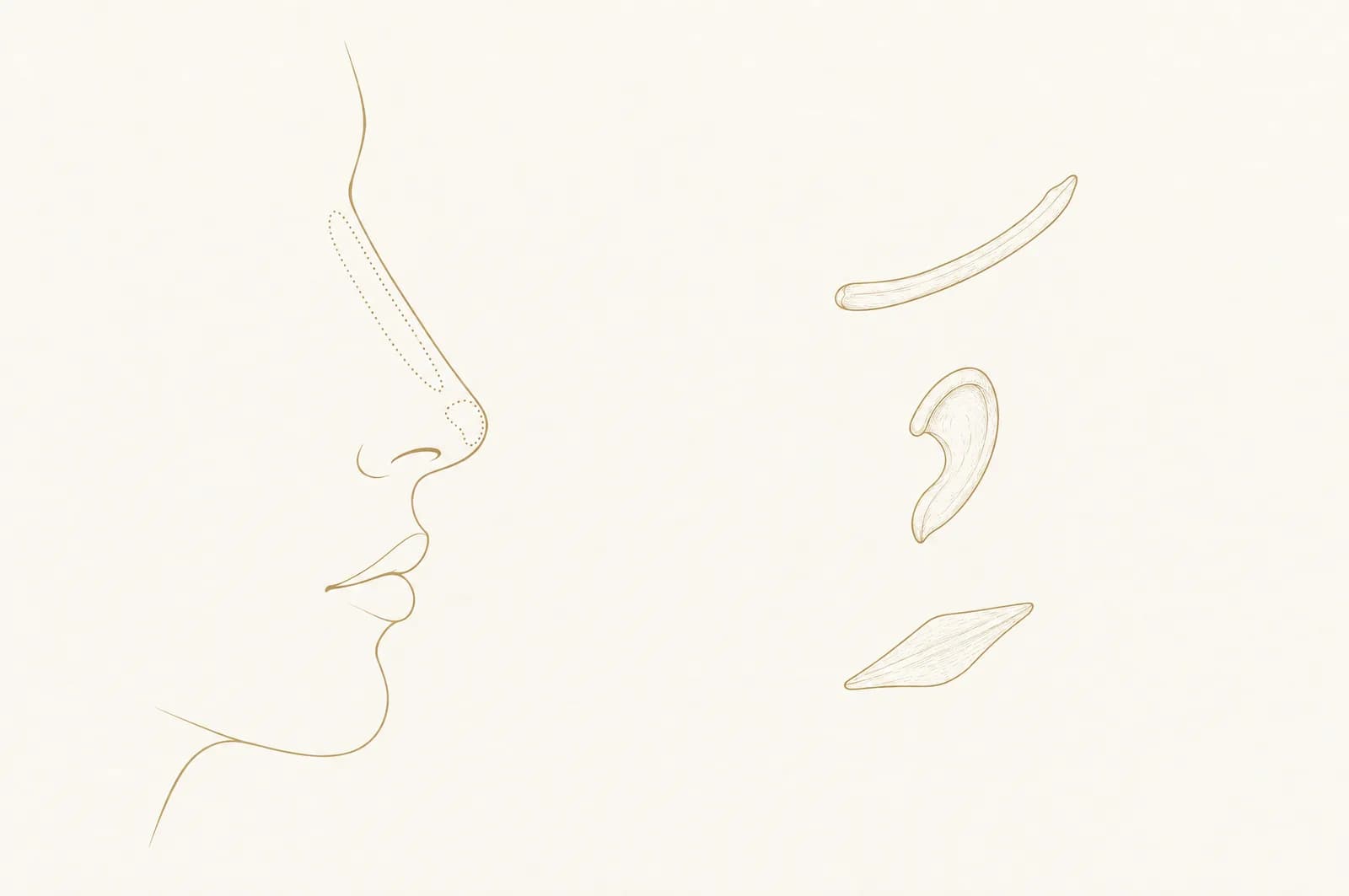
Most Korean rhinoplasty does two jobs at once. Something raises the bridge, the line from between your eyes down to the tip, and something supports and shapes the tip itself. The bridge needs a smooth, even piece of material. The tip needs small, firm grafts that keep their shape under the skin.
The materials fall into two groups. Implants are manufactured: a ready-made silicone implant, a silicone implant shaped from a scan of your face, or Gore-Tex. Tissue grafts come from your body or from a donor: cartilage from your septum, ear or rib, rib cartilage from a tissue bank, or soft layers called dermis and fascia. Many plans mix the two, such as a silicone bridge with septal cartilage at the tip, as our rhinoplasty page describes.
Urban Plastic Surgery, our partner clinic, lists ear, septal and rib cartilage, your own dermis, fascia, silicone and 3D custom implants among the materials it uses. Gore-Tex is not on that list. We still explain it here, because many people search for it and some arrive in Seoul with Gore-Tex from an earlier surgery.
How do the materials compare?
Complication rates differ a lot between studies and surgeons, and your skin, the change you want and any earlier surgery matter as much as the material. Use these trade-offs to prepare questions for your consultation.
| Material | What it is | Usually used for | Main trade-offs | Removal or revision |
|---|---|---|---|---|
| Silicone implant | A ready-made solid silicone piece, carved to fit your bridge | Bridge height | A capsule of scar tissue forms around it and can tighten (capsular contracture). The implant can also shift, show through thin skin or become infected | Usually simpler than other implants, because tissue does not grow into it |
| 3D custom nose implant | Silicone shaped to your face from a 3D CT scan | Bridge, especially after injury or with clearly uneven bone | The same capsule, contracture and infection risks as other silicone. Needs a CT scan first | As for a silicone implant |
| Gore-Tex (ePTFE) | A softer, porous synthetic material | Bridge. Not on our partner clinic’s list | Tissue grows into its pores. Like any implant it can become infected or push through the skin | More involved than silicone, because tissue has grown into it |
| Septal cartilage | Cartilage from the wall between your nostrils, taken through the same incision | Tip support, lengthening, small bridge grafts | Limited amount, and earlier surgery may have used it up. No extra wound outside the nose | Your own tissue. Can be reshaped or added to in a revision |
| Ear cartilage | Soft, curved cartilage from the bowl of the ear | Tip shaping and small corrections | Too soft and small for a large bridge. The ear is sore for a while | Can be trimmed or replaced in a revision |
| Your own rib cartilage | Cartilage from a rib, taken through a short chest incision | Large bridge grafts, strong tip support, short or contracted noses, revisions | A chest scar and soreness. Grafts can warp over time | Can be trimmed or replaced. Taking more rib means another wound |
| Donor rib cartilage | Rib cartilage from a tissue bank, processed before use | The same uses as your own rib | No chest wound. It is not your own living tissue, and long-term comparisons with your own rib are limited | Can be trimmed or replaced in a revision |
| Dermis | A deep layer of your own skin with the surface removed | A soft layer to smooth the bridge or cover grafts under thin skin | Needs a small donor wound. How much volume it keeps varies | Your own tissue |
| Fascia | A thin sheet of your own connective tissue | Wrapping finely diced cartilage for the bridge, or a cushion over grafts | Needs a small extra incision | Your own tissue |
Silicone, 3D custom or Gore-Tex: what is the difference?
A silicone implant is a smooth, solid piece that the surgeon carves to your bridge. Your body forms a thin capsule of scar tissue around it, which holds it in place. Silicone does not bond to the tissue, so if it shifts, shows or becomes infected it can usually come out more easily than a material that tissue has grown into. The capsule is also the main drawback. It can thicken and tighten over time and pull the tip up, leaving a short, hard nose known as a contracted nose.
A 3D custom nose implant is still silicone, but it is shaped from a 3D CT scan so that it follows the shape of your bridge. Our partner clinic suggests it for a nose changed by injury or for clearly uneven bone, where a ready-made implant may sit poorly. The clinic lists about 1 to 2 hours under sedation, stitches out on day 7 to 10 and 2 to 3 follow-up visits. Because it is silicone, the capsule, contracture and infection risks are the same as for a standard implant.
A Gore-Tex nose implant, made of expanded polytetrafluoroethylene (ePTFE), is softer and porous. Tissue grows into its pores, which helps it stay in place and can make it feel less firm than silicone. The same ingrowth makes removal more involved if it ever has to come out. Like any implant, it can become infected, and an infected implant usually has to be removed. If you have Gore-Tex from an earlier surgery, mention it early, because it changes how a revision is planned.
All implants share the same basic risks: infection, shifting, showing through thin skin and, less often, pushing through it (extrusion). A review of 581 revision rhinoplasties after implant surgery, looking at problems with implant materials, found that most of the implants were silicone or Gore-Tex, and that infection and extrusion were among the main reasons people needed another operation.
When does your own cartilage make sense?
Your own cartilage is living tissue, so it does not form a capsule the way an implant does. The trade-off is a donor site and, for ear or rib, a second wound. Which source the surgeon uses depends on how much cartilage the plan needs, how strong it must be and what earlier surgery has already used. Our page on rhinoplasty with your own cartilage covers recovery and stay.
Septal cartilage comes from inside your nose through the same incision, so there is no extra scar. It is the usual choice for tip support in a first surgery, but the amount is limited. Ear cartilage is soft and curved. It suits tip shaping and small corrections, but not a large bridge.
Rib cartilage gives the most material and is strong enough for a full bridge, a longer nose or rebuilding after several surgeries. Our partner clinic lists the 6th to 10th ribs as the area it takes rib cartilage from, through a short incision on the chest. A meta-analysis of 10 studies with 491 patients found warping in 3.08%, resorption in 0.22%, infection in 0.56% and a thick (hypertrophic) chest scar in 5.45%, with wide variation between studies. Warping means the graft slowly bends and can tilt the bridge, which may need correction. Rarely, taking the rib can also let air leak around the lung.
Dermis and fascia add softness, not support. Dermis can smooth a bridge or cover grafts where the skin is thin. Fascia is often wrapped around finely diced cartilage, so the bridge is built from many small pieces instead of one carved block. Both need a small extra incision, and how much volume they keep varies from person to person.
Your own rib or donor rib: what is the difference?
Rib cartilage for a nose can come from 2 places: your own chest, harvested during the same operation, or a tissue bank, which supplies donor rib cartilage already processed for surgery. Our partner clinic compares the two on its own page: donor rib is irradiated and needs no harvest surgery, and the clinic names infection as its drawback compared with your own rib.
The research is less clear-cut. A 2020 meta-analysis of 28 studies with 1,041 patients found no difference between your own and donor rib in warping, resorption, infection, contour irregularity or revision surgery. All 28 studies looked back at past patients, and long-term data are limited, so surgeons still differ in which they prefer.
In practice the choice comes down to trade-offs you can name: a chest scar and more soreness, against tissue that is not your own. Ask the surgeon which they would use for your nose and why, how often they use each, and how they would handle warping or resorption if it happened.
| Point | Your own rib | Donor rib |
|---|---|---|
| Where it comes from | Your rib, taken in the same operation | A tissue bank. Processed before use (irradiated, at our partner clinic) |
| Extra wound | A short chest incision, often sore for longer than the nose | None |
| Donor-site scar | A chest scar. Thick scarring in 5.45% in one meta-analysis | No donor scar |
| Warping, resorption, infection | Low rates in pooled studies, with warping the most common | No clear difference from your own rib in a 2020 meta-analysis. The clinic names infection as its drawback |
| Operating time | Longer, because the rib is taken first | Shorter |
| Often suits | People who want only their own tissue and accept a chest scar | People who want to avoid a chest wound and a longer operation |
Which material suits which nose?
Your surgeon decides after examining your skin, checking how much cartilage you have left and agreeing on the shape you want. These are common starting points.
- A low bridge, skin thick enough to cover an implant and no earlier surgery: often a silicone implant for the bridge and septal cartilage for the tip.
- Thin skin, or a worry that an implant will show: your own cartilage, sometimes with dermis or fascia as a soft cover.
- A short or upturned nose that needs lengthening: firm septal or rib cartilage at the tip, because a longer nose needs strong support.
- A nose changed by injury, or bone that is clearly uneven: a 3D custom implant shaped from a CT scan may sit better than a ready-made one.
- No implant at all: your own cartilage, with rib if the change in height is large. Rib means a chest scar, so weigh that before you decide.
- A straighter, stronger bridge for a male face: the same materials apply, with height and angle set differently. See what men change in rhinoplasty.
What changes when the nose has had surgery before?
A revision rhinoplasty often starts by taking out what is already there. A silicone implant usually comes out in one piece, along with scar tissue where needed. Gore-Tex takes more careful work, because tissue has grown into it. If an implant is infected, the surgeon decides whether to rebuild in the same operation or let the area heal first.
Rebuilding narrows the choice of material. A first surgery often uses most of the septal cartilage, and scar tissue can pull a nose short. That is why rib cartilage, your own or from a donor, comes up so often in revision plans. Skin that has been operated on can be thinner and covers a new implant less well, which is another reason surgeons look at tissue options.
Bring whatever you know about your first surgery: the material, the implant brand if there was one, and the operation notes. Our guide to planning revision surgery lists what to collect and how long to wait before a second operation.
What changes the cost, and what should you ask?
We do not publish prices yet, since each nose plan is priced on its own. The material is one of the main variables. The others are the number of areas being reshaped, any work on the nasal bones and whether this is a revision. The questions below make quotes easier to compare, and our surgery quote checklist covers the rest.
Rib cartilage changes the price in its own way. Your own rib adds a second surgical site and more operating time. Donor rib adds the cost of the processed tissue. In both cases, how much cartilage the plan needs and whether an implant is also used move the price, so the written quote should say where the cartilage comes from.
If you want to ask before you travel, start a free consultation. A patient coordinator answers first, then the surgeon at the partner clinic that fits your case reviews your photos and consults in depth. Which material goes into your nose is a medical decision for the surgeon, since the coordinator is not a doctor. You can also browse all nose surgery options.
- Which material for the bridge and which for the tip, and why for my nose?
- If cartilage is used, from where, how much, and is it my own or from a donor?
- If an implant is used, is it ready-made or 3D custom, and what is the brand or product?
- What happens if the implant shifts, shows or becomes infected, and what would removal involve?
- Who operates, and which anesthesia does this plan need?
- Does the quote include the CT scan, anesthesia, follow-up visits, the splint and stitch removal?
More questions
Silicone vs rib cartilage: which is safer for rhinoplasty?
Neither is free of risk. Silicone can shift, show, tighten into a contracted nose or become infected, and an infected implant usually has to come out. Rib cartilage avoids a foreign body but adds a chest wound and can warp. Which is safer for you depends on your skin, the change you want and any earlier surgery, so ask the surgeon to explain the risks for your own nose.
Does a silicone nose implant need replacing after a few years?
There is no set replacement date for a nose implant. It is taken out or exchanged when a problem appears, such as shifting, showing through the skin, contracture or infection, or when you want a different shape. Keep a note of the implant type and brand, because any future surgeon will ask for it.
Can I have rhinoplasty without any implant?
Yes. Your septal, ear or rib cartilage can build the bridge and tip without an implant. A large change in height usually needs rib cartilage, which means a chest scar. A small change at the tip may need only septal or ear cartilage.
What is diced cartilage wrapped in fascia?
It is a way to build up the bridge with your own tissue. Cartilage is cut into very small pieces, wrapped in a thin sheet of fascia and placed along the bridge. Ask the surgeon whether it suits your skin and the height you want.
Is a 3D custom implant better than a standard silicone implant?
Not for everyone. It is shaped from a CT scan, which helps when injury or uneven bone makes a ready-made implant sit poorly. It is still silicone, with the same capsule and infection risks. For a typical low bridge, a carved standard implant may do the same job.
Procedures in this article
Sources
- Complications associated with autologous rib cartilage use in rhinoplasty: a meta-analysis. PubMed, US National Library of Medicine
- Comparison of Autologous vs Homologous Costal Cartilage Grafts in Dorsal Augmentation Rhinoplasty: A Systematic Review and Meta-analysis. PubMed Central, US National Library of Medicine
- Problems Associated with Alloplastic Materials in Rhinoplasty. PubMed Central, US National Library of Medicine
- Prevalence of complications associated with polymer-based alloplastic materials in nasal dorsal augmentation: a systematic review and meta-analysis. PubMed Central, US National Library of Medicine
- The current techniques in dorsal augmentation rhinoplasty: a comprehensive review. PubMed Central, US National Library of Medicine