Nose
Rhinoplasty with your own cartilage in Korea
Cartilage rhinoplasty shapes the nose with your own septal, ear or rib cartilage, instead of an implant or alongside one. Rib cartilage rhinoplasty suits plans that need strong support or a lot of material; septal or ear cartilage often covers smaller changes. Surgery takes about 2 hours under sedation or general anesthesia. Plan 7 to 10 days in Seoul.
Who is a good candidate for rhinoplasty with your own cartilage?
- You prefer not to have an implant, or an earlier implant caused problems
- Your nose is small or has weak support and needs a stronger framework
- You have thin skin and worry about an implant showing through
- Your nose is short or upturned and needs firm support to lengthen it
When it may not be the right choice
- You want the shortest possible recovery. Taking ear or rib cartilage adds a second wound, and any cartilage harvest adds operating time
- You want a large change in height but no wound outside the nose. That much material often means rib cartilage and a chest scar
Which method fits you?
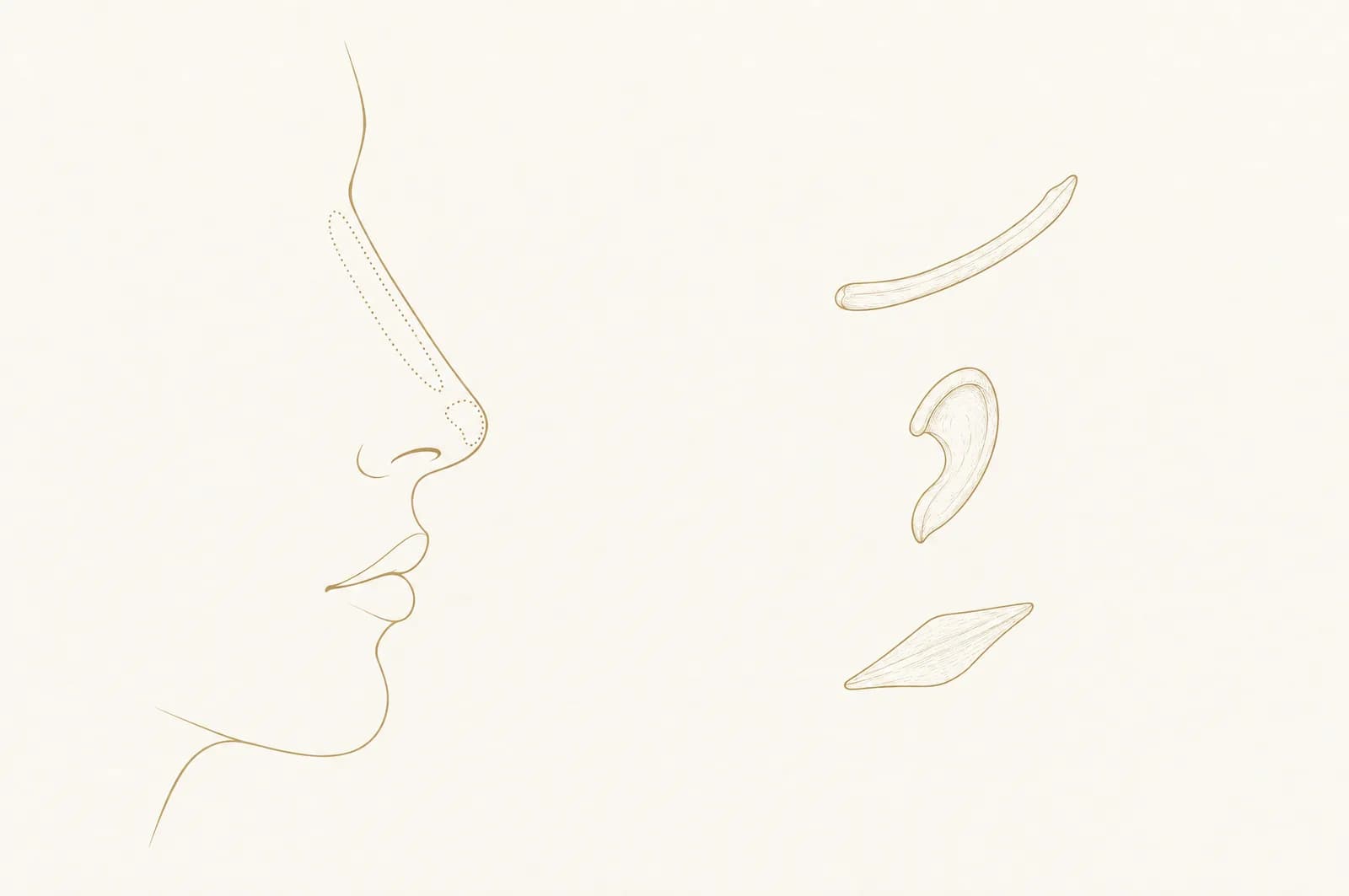
Rhinoplasty with your own cartilage can draw on three donor sites, and rib cartilage is not always needed. The surgeon’s choice rests on the amount the plan calls for, the strength or curve each graft needs and what earlier surgery has already taken.
| Method | What happens | Suits | Downtime |
|---|---|---|---|
| Septal cartilage | Taken from the wall inside your nose that divides the two sides, through the same incision as the rhinoplasty. | Tip support and lengthening, and small bridge grafts. The amount is limited and may be used up after earlier surgery | No extra wound outside the nose. Stitches out on day 7 to 10 |
| Ear cartilage | Taken from the bowl of the ear through a small incision. It is soft and curved. | Tip shaping and small corrections. Too soft and small for a large bridge | Stitches out on day 7 to 10. The ear is sore for a while |
| Rib cartilage | Taken through a short incision on the chest. It gives the most material and is firm enough for large grafts. | A lot of added height, a short nose or one pulled tight by scar tissue, or rebuilding after several surgeries | Stitches out on day 7 to 10. The chest is usually sore for longer than the nose |
What happens on the day of rhinoplasty with your own cartilage?
- Consultation. The surgeon checks your septum, your ears and how much support your tip needs, then decides on the cartilage source with you.
- Sedation or general anesthesia, depending on the plan.
- The cartilage is taken, carved into grafts and placed through a small cut at the base of the nose. This takes about 2 hours.
- A splint goes over the nose, and the ear or chest wound, if there is one, is dressed as well. The clinic lists no overnight stay; ask whether this changes after rib cartilage.
What is recovery like after rhinoplasty with your own cartilage?
- Days 1 to 3
- The splint is on, with swelling and bruising around the eyes. If rib cartilage was taken, your chest hurts when you move, cough or breathe deeply.
- Days 7 to 10
- Stitches come out and the splint comes off. The tip is swollen and feels firm.
- Weeks 2 to 4
- Bruising has mostly gone and you can be out and about. Keep pressure off the nose, and off the chest after a rib graft, and skip hard exercise.
- Months 3 to 12
- Swelling keeps going down and the tip slowly refines. The final shape is usually judged at about a year.
How long should you stay in Seoul after rhinoplasty with your own cartilage?
Stitches come out between day 7 and day 10, and you fly once they are out, usually around day 8 to 10. That makes 7 to 10 days in Seoul the range to plan for. A rib graft is a reason to aim for the longer end, since chest soreness tends to outlast the nose. As after any operation, if you become breathless or have chest pain, get emergency care first, then tell the clinic. If rib cartilage is used, soreness at the chest wound that eases day by day is expected, but chest pain that comes on suddenly or gets worse needs emergency care first, then a call to the clinic. A nosebleed that is heavy and does not stop also needs emergency care first, then the clinic. After any of these, do not fly until a doctor says it is safe. For the first weeks, skip nose blowing, alcohol, saunas and swimming.
What are the risks of rhinoplasty with your own cartilage?
- Swelling, bruising and a numb, stiff tip, which settle over weeks to months
- A rib cartilage graft that warps over time and bends the bridge, which may need correction
- With rib cartilage: chest pain, a chest scar and, rarely, air leaking around the lung
- With ear cartilage: soreness or a visible change at the ear
- A graft that shows through thin skin or shifts, which may need another operation
- Infection, which published reviews report less often with your own cartilage than with implants
- Asymmetry, breathing difficulty or a result you do not like, sometimes corrected by revision surgery
What affects the cost of rhinoplasty with your own cartilage in Korea?
Cartilage rhinoplasty has no listed price yet; the clinic quotes once it has your photos. The amount depends on where the cartilage comes from and how much is needed, on sedation or general anesthesia, on whether an implant is used as well, and on whether bone is cut. Your written quote should state the surgeon and the cartilage source, with anesthesia, follow-up care, splint and stitch removal itemized.
More questions
Do I need rib cartilage for my rhinoplasty?
Not always. Many first surgeries use septal cartilage, and ear cartilage can be enough for small tip changes. Rib cartilage is used when the plan needs a lot of strong cartilage, or when earlier surgery has used up the septum.
Is my own cartilage safer than an implant?
Published reviews report lower rates of infection and extrusion (material pushing out through the skin) with your own cartilage. It has its own risks, though: a second wound when ear or rib cartilage is used, and rib grafts can warp. Both choices carry risks, so ask the surgeon which ones apply to your nose.
Will the rib cartilage scar show?
There is a scar on the chest. Its length and position depend on how much cartilage is needed and on the surgeon’s technique. Ask the surgeon to show you where it will be before you decide.
Is donor rib cartilage the same as my own?
No. Donor rib cartilage is taken from a tissue bank and processed before it is used, which spares you a chest wound. A systematic review of rib grafts used to raise the bridge found similar rates of warping, resorption and infection for donor and your own rib. Ask the surgeon which one they would use for you, and why.
When can I fly home after cartilage rhinoplasty?
Usually after the stitches come out, around day 8 to 10. If rib cartilage was taken, expect your chest to feel sore on the flight.
Related procedures
Sources
- Clinic figures as published by Urban Plastic Surgery, collected October 3, 2026. Your surgeon confirms your own plan.
- Complications associated with autologous rib cartilage use in rhinoplasty: a meta-analysis. PubMed, US National Library of Medicine
- The Use of Auricular Cartilage Grafts in Septorhinoplasty: A Dual-Centre Study of Donor Site Patient-Reported Outcome Measures. PubMed Central, US National Library of Medicine
- Outcomes and complications of autologous versus alloplastic grafts in augmentation rhinoplasty: A systematic review of studies from 2000 to 2024. PubMed Central, US National Library of Medicine
- Comparison of Autologous vs Homologous Costal Cartilage Grafts in Dorsal Augmentation Rhinoplasty: A Systematic Review and Meta-analysis. PubMed Central, US National Library of Medicine
Cases and clinic figures come from our partner clinic, Urban Plastic Surgery. The partnership does not change what we publish about risks and recovery.