GuidesMen
Masculine nose shape: what men usually change in rhinoplasty
In rhinoplasty for a masculine nose, men usually want a straight, strong bridge, a defined tip that is not upturned or pinched, and a shape that suits their face and heritage. A hump or crooked nose is often fixed in the same operation, which takes about 1 to 2 hours under sedation. Allow 7 to 10 days in Seoul.
What do men usually want from rhinoplasty?
Men often describe what they want to avoid as clearly as what they want to change. Common requests include:
- A straight bridge in profile, without a hump and without a scooped dip
- Enough height along the bridge to give the face a stronger line, especially where the bridge is low between the eyes
- A tip that points forward rather than up, so the nostrils do not show much from the front
- A tip that is defined but broad enough for the face, not narrow or pinched
- Easier breathing, when the septum is bent or the nose was broken before
- A result that keeps their ethnic character and still looks like their own nose
How long does rhinoplasty for men take?
Urban Plastic Surgery, our partner clinic, offers rhinoplasty for men as a straight nose rhinoplasty. The clinic suggests it for men who want a masculine, straight bridge, and for those who also need their breathing improved in the same operation.
The operation lasts about 1 to 2 hours under sedation, and no overnight stay is needed. Stitches come out after about 1 week, and the clinic lists about 1 week to get back to daily life. The main rhinoplasty page explains each method and what the recovery involves.
How does a male nose plan differ from a female one?
Surgeons use the same techniques for men and women, but the target shape often differs. A plan built around typical requests from women can leave a man’s nose looking too soft.
The table below shows common tendencies. Plenty of women want a straight, strong bridge, and some men prefer a softer line. Our partner clinic plans rhinoplasty in two styles: a more defined, angular line or a softer, more natural one. Either can be adapted to a man’s face.
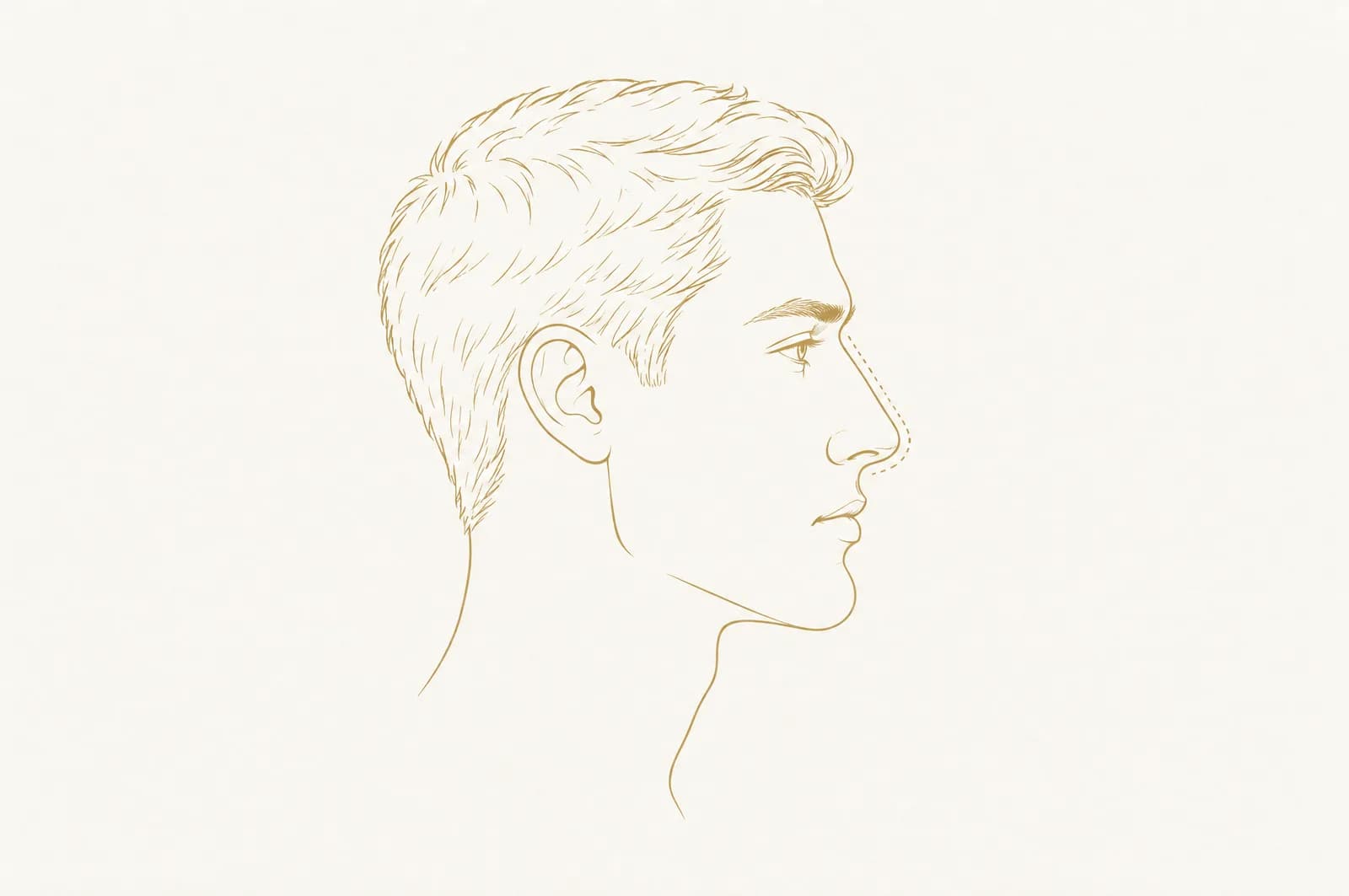
Angles belong in the plan too. On your profile photos, surgeons look at the angle between the base of the nose and the upper lip, and at how far the tip projects. Ask the surgeon to show these on your own face, since a single number for all men does not fit every profile.
| Feature | Common request from men | Common request from women |
|---|---|---|
| Bridge line | Straight and strong | Straight, or with a slight curve above the tip |
| Bridge height and width | Higher, and not too narrow | Slimmer |
| Tip direction | Pointing forward, little upturn | Often slightly upturned |
| Tip shape | Defined but broad enough for the face | Smaller and more refined |
| Overall size | In proportion to a broader face and jaw | Often a smaller, softer nose |
Can a hump or a crooked nose be fixed at the same time?
Yes, and many plans for men include one or both. A hump in the middle of the bridge can be there from birth or follow an injury. A crooked nose can come from bent nasal bones or a bent septum, the wall of cartilage that divides the inside of the nose, and a bent septum may come with a blocked nose, rhinitis or headaches.
Hump nose correction takes the hump down and, when the bridge is left wide, cuts the nasal bones to narrow it. Crooked nose correction straightens the bones and the septum. At the partner clinic both follow its standard rhinoplasty figures, about 1 to 2 hours under sedation with 2 to 3 follow-up visits, and when the bones are cut the splint and stitches can stay until day 10.
For men, the main design risk is taking too much off. A hump lowered past a straight line leaves a scooped bridge, which reads as soft in profile. You can ask for the hump to be taken only to a straight line, or for a trace of it to stay. If breathing is part of the problem, say so at consultation, because work on the septum changes the plan and the recovery.
Which materials suit a stronger bridge?
A low nose bridge needs added height to look straight and strong, and that height comes from an implant, your own cartilage or both. Our guide to nose implant materials compares them side by side. In short:
- Silicone implant: quick to place and removable. It needs enough skin over it, and it can shift, show through thin skin or become infected, which can mean taking it out.
- Septal cartilage: taken from inside the nose through the same incision. It is the usual choice to support the tip, but the amount is limited.
- Rib cartilage: the most material, firm enough for a large, straight bridge or a short nose that needs lengthening. It adds a short scar on the chest and a longer operation. The rib cartilage rhinoplasty page covers it in detail.
- 3D custom implant: made to the shape of your nose. The partner clinic suggests it for noses with an old injury or marked bony asymmetry.
How does skin thickness change the result?
Your skin decides how much of the shape underneath shows. Thick, oily skin on the tip, which is common in East Asian noses, hides fine detail, so a very sharp or narrow tip is hard to achieve under it. It also holds swelling longer, and the tip can take up to a year to refine.
For a masculine plan this is often workable. A defined but broad tip suits a male face, and thick skin covers an implant well. Thin skin is the opposite: the edge of an implant or graft shows more easily, which is one reason surgeons turn to your own cartilage on a thin-skinned bridge.
The surgeon checks your skin by touch and on photos. If your skin is very thick, ask what tip shape is realistic for you and how long the swelling usually lasts for skin like yours.
When can you go back to work and the gym?
Allow 7 to 10 days in Seoul for the trip. The splint and stitches come off at the check around day 7, and a flight home around day 8 is typical. Some plans keep the splint or stitches in until day 10: when the bones are cut, when the tip is reshaped without an implant, and when the nose is built only from your own cartilage, such as rib cartilage, or with a 3D custom implant. If that applies to you, book your flight for the end of that range. Keep away from nose blowing, alcohol, saunas and swimming for the first few weeks, or until your surgeon clears them.
A desk job is usually possible soon after the splint is off. If you would rather not explain the bruising, allow 2 to 3 weeks before meetings in person. Heavy glasses rest on the bridge, so ask your surgeon when you can wear them again. If you lift weights, play contact sports or wear a helmet at work, raise it at consultation so the plan covers it. For the whole trip, see our week-by-week surgery trip plan.
| When | What it usually looks like | What most people can do |
|---|---|---|
| Days 1 to 3 | Splint on, swelling and bruising around the eyes at their peak | Rest at the hotel, sleep with the head raised |
| Around day 7 | Splint and stitches out, tip puffy, stiff and numb | Light desk work and video calls, fly home around day 8 |
| Weeks 2 to 3 | Most bruising has faded | Back at work and comfortable in public |
| Weeks 4 to 6 | Swelling keeps going down | Hard exercise again if the surgeon agrees |
| Months 6 to 12 | Shape more defined, tip still refining | Judge the final shape toward the end of this period |
How do you avoid a result that looks too feminine?
When a man’s nose looks too feminine after surgery, the cause is usually one of a few things: a tip turned up too far, a bridge scooped too low after a hump is removed, a nose made too narrow or small for the face, or a tip pinched too thin. Each is easier to avoid when it is named before surgery.
- Bring front and profile photos of men’s noses you like, ideally on faces like yours, and 1 or 2 you do not like.
- Say what you want to keep: the width, a slight bump, the strength of the bridge or your ethnic character.
- Ask the surgeon to show the planned tip direction and bridge line on your own profile photo.
- Ask how far the hump will be lowered and whether the bridge will end straight or with a dip.
- Ask which material is planned for the bridge and for the tip, and what a later change would involve.
- If you have had nose surgery before, bring the records. A second operation is planned differently, so read our revision surgery planning guide and the revision rhinoplasty page first.
What are the risks, and how do you start?
The risks are those of any rhinoplasty. Swelling and a stiff, numb tip are expected and settle over weeks to months. The nose is usually blocked for the first week or so, and in some people breathing stays harder than before. Light nosebleeds can happen in the first few days, but bleeding that is heavy or will not stop needs emergency care first, then a call to the clinic. Infection can mean an implant has to come out, and an implant can shift or show through thin skin. Asymmetry or a shape you are unhappy with may need a revision. If rib cartilage is taken, it adds chest pain, a chest scar and, rarely, air leaking around the lung. As after any operation, if you become breathless or have chest pain, get emergency care first, then tell the clinic. If rib cartilage is used, soreness at the chest wound that eases day by day is expected, but chest pain that comes on suddenly or gets worse needs emergency care first, then a call to the clinic.
You can start before you travel. Through our free consultation, a patient coordinator answers first and passes your photos to the partner clinic that fits your plan, where the surgeon consults with you in depth. Bridge height, tip direction and any breathing work are medical decisions for that surgeon, because your coordinator is not a doctor. Other options for men are on the plastic surgery for men page.
More questions
Is rhinoplasty for men a different operation?
No. Male rhinoplasty uses the same techniques as rhinoplasty for anyone else. What differs is the design: the bridge height, tip direction and width the surgeon aims for. At the partner clinic the straight nose rhinoplasty for men has the same surgery time as its standard rhinoplasty.
Can I keep my ethnic nose and still make it stronger?
Yes. The surgeon can raise or straighten the bridge and refine the tip while keeping the width and character that fit your face. Bring photos of noses you like from your own background, so the surgeon sees the direction you mean.
Can rhinoplasty fix my breathing as well?
Often, yes. If a bent septum or an old fracture blocks your nose, the septum can be straightened in the same operation as the shape change. Tell the surgeon about blockage, snoring or past injuries, because a breathing problem changes the plan.
Is a silicone nose implant a bad idea for men?
Not in itself. Silicone is widely used on the bridge and can be removed if needed. It suits skin thick enough to cover it. Your own cartilage is the usual alternative if your skin is thin, you have had infections in the nose or you would rather avoid any implant. Ask the surgeon which fits your nose.
Can I combine rhinoplasty with other surgery on the same trip?
Often, for example with eyelid surgery or facial fat grafting. Combining changes the operation time, the anesthesia and the recovery, so ask the surgeon how many days to plan. Sometimes the surgeon will suggest splitting procedures into two trips.
Procedures in this article
Sources
- Current Update in Asian Rhinoplasty. PubMed Central, US National Library of Medicine
- Rhinoplasty. StatPearls, NCBI Bookshelf, US National Library of Medicine
- Rhinoplasty Risks and Safety. American Society of Plastic Surgeons
- Rhinoplasty Recovery. American Society of Plastic Surgeons
- Nose reshaping (rhinoplasty). NHS