GuidesBody
Multiple area liposuction: how much can you do in one trip?
Multiple area liposuction has no fixed number of areas per session. The limit depends on the total amount removed, your body weight and health, and how long you can safely be under anesthesia. Nearby areas such as the belly and flanks are often treated together, and larger plans can be split over 2 trips. Plan about 7 nights in Seoul.

What decides how much liposuction you can have at once?
Surgeons plan liposuction by the total amount removed and the operating time. A plan with 3 small areas can remove less fat than a plan with 1 large area. These are the main things that set the limit for one session:
- Total volume. The surgeon removes fat together with the fluid injected to numb the area and reduce bleeding. Studies usually call a session large-volume once more than 5 liters of fat and fluid come out.
- Your body weight. A study reported by the American Society of Plastic Surgeons found that the safe amount varies with body weight: complications became more likely as the volume removed grew relative to body mass index (BMI).
- Time under anesthesia. Each extra area adds operating time, and treating both the front and back of the body means you are turned over during surgery. The partner clinic lists 1 to 3 hours for large-volume liposuction under general anesthesia.
- Blood loss and fluid balance. Fluid goes in, and fat, blood and fluid come out. Large shifts in body fluid can strain the heart and kidneys, which is one reason surgeons set volume limits.
- Your health. A condition that affects healing or blood clotting, smoking, or a blood thinner you cannot stop can lower the safe limit or rule surgery out.
Which areas are often treated together?
Areas that sit next to each other, and can be reached without turning you over, are the simplest to combine. A single compression garment can then cover all of them. Single areas that are often combined include abdominal liposuction, arm liposuction and thigh liposuction.
If your skin is loose or your belly is firm from fat deep around the organs, liposuction may not give the change you want, however many areas are treated. A tummy tuck (abdominoplasty) removes loose skin, which liposuction does not.
| Combination | Why people pair them | Check with the surgeon |
|---|---|---|
| Belly and flanks | Neighboring areas that shape the waist together | Whether your skin is firm enough to shrink back |
| Both upper arms | Treated in one session so the two sides match | Whether the area toward the armpit is included |
| Inner and outer thighs | A more even contour around the thigh | How walking and sitting will feel in the first days |
| Belly, flanks and thighs | A larger plan for the lower body | Total volume, anesthesia time and whether to split it |
| Liposuction with fat transfer | Removed fat is moved to the face or breasts | Extra operating time and a second area to heal |
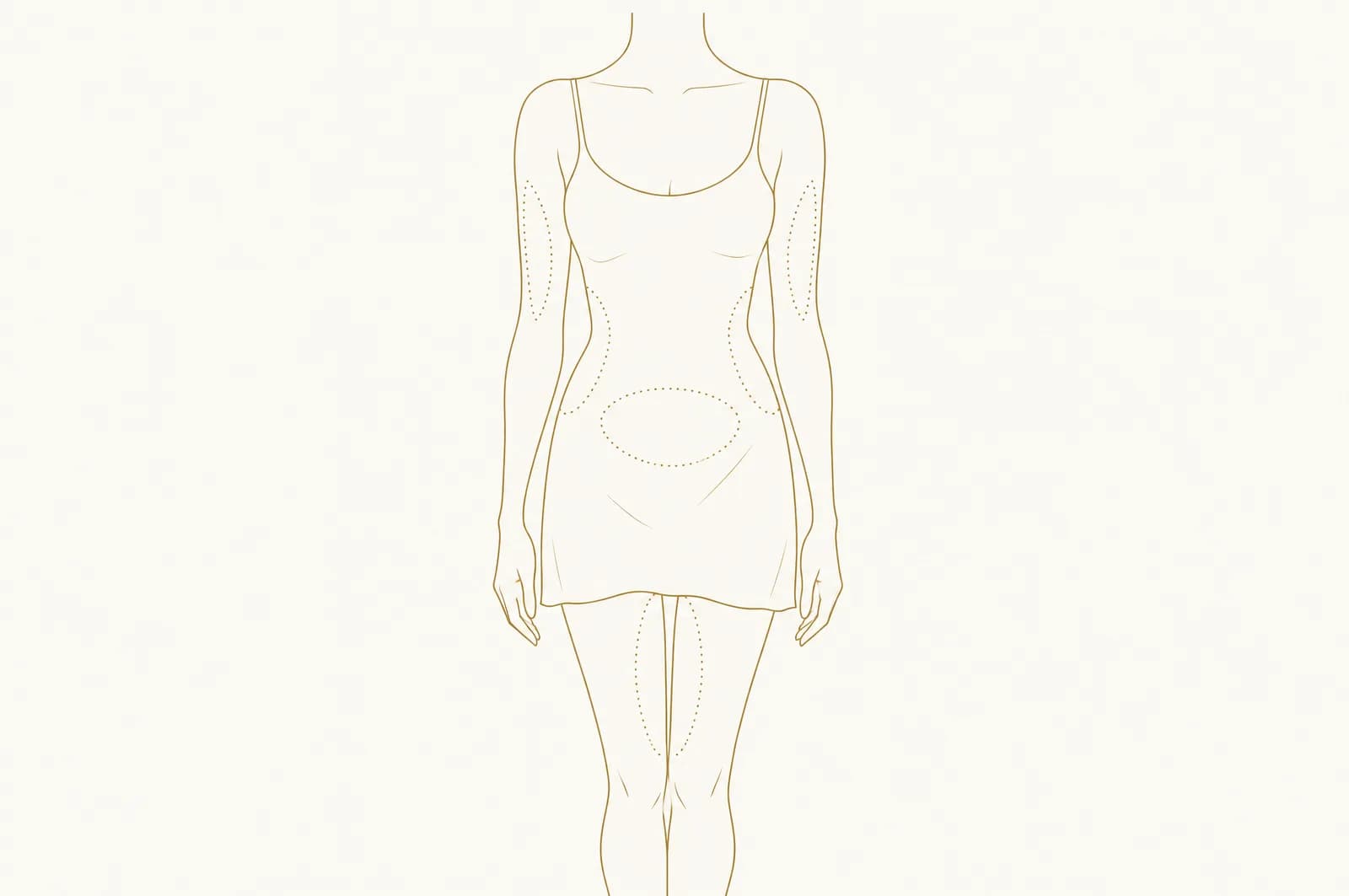
How does the partner clinic list its liposuction options?
Urban Plastic Surgery, our partner clinic, describes its liposuction as done by hand with fine cannulas (the thin tubes that remove the fat), which need small entry cuts. Whatever the technique, the safe volume still depends on your body and the total plan. The clinic states that an anesthesiologist is always on site; for a longer session, ask who will give your anesthesia and who will monitor you. The main liposuction page explains the operation step by step.
The clinic lists 3 kinds of liposuction, shown below with its figures and our note on soreness; your own plan may differ. For all 3, the clinic lists the same aftercare: no drain, and the stitch check and stitch removal about 1 week after surgery.
| Type | Areas | Surgery time | Anesthesia | Back to daily life |
|---|---|---|---|---|
| Mini liposuction | One small area | 15 to 30 minutes | Not listed by the clinic; ask at consultation | Light daily life right away; sore for a few days |
| Single-area liposuction | One area, such as the upper arms, thighs or calves | Up to 1 hour | Sedation | Light daily life right away; sore for a few days |
| Large-volume liposuction | Larger areas such as the arms, belly or thighs | 1 to 3 hours | General anesthesia | In 3 to 5 days |
When is it better to split liposuction over 2 trips?
Staging means treating some areas now and the rest in a later session. You take on a second trip, a second anesthetic and a second recovery, and in return each session stays within the volume and time limits your surgeon sets. If you stage, ask how long the surgeon wants between sessions and plan the second trip around that. Ask for both sessions to be written into the first plan, so you can compare the total cost and recovery with one longer operation.
Splitting is worth discussing when:
- the total volume for all your areas would go past the limit your surgeon sets for you
- the areas are on both the front and back of your body, so you would be turned during surgery
- you have a health condition that makes a long anesthetic less safe
- you also want fat transfer, which adds time and another area to heal
- you would like to see how your skin responds in one area before treating the next
What is recovery like after several areas?
More areas mean more swelling, bruising and soreness at the same time, and moving around is harder when your belly and thighs are both sore. Bring or buy more than one compression garment so you can wash them, and check that the garment covers every treated area. A garment for the belly and thighs is a different shape from one for the arms, so a mixed plan may need both.
Day by day, recovery follows the same pattern as after one area:
- Days 1 to 3: swelling, bruising and soreness in every treated area at once, with some fluid leaking from the small cuts. Get up for short walks even when several areas are sore, because moving helps your circulation.
- Days 3 to 5: most people are back to light everyday activities after large-volume liposuction.
- Day 7: stitch check and removal at the clinic.
- Weeks 2 to 6: keep the garment, or garments, on every treated area for as long as your surgeon advises, usually several weeks, and ask when strenuous exercise can restart, since it is usually off limits for at least the first couple of weeks.
- Months 1 to 6: the contour shows as swelling fades, often by 1 to 3 months, though one area can settle later than another and take up to 6 months.
How long should you stay in Seoul, and when can you fly?
Plan about 7 nights in Seoul. That covers surgery, the days when swelling is worst and the stitch check at about 1 week, after which most people can fly. If several areas are treated under general anesthesia, ask whether a night at the clinic is part of the plan, and book your hotel nights around it. The surgery trip timeline shows how these days fit around arrival, consultation and the flight home.
Liposuction carries a risk of blood clots in the legs or lungs, and sitting still for hours on a flight soon after surgery adds to that risk. On the way home, wear your compression garment, walk the aisle when you can, move your ankles while seated and drink water. Tell the surgeon before surgery if you have ever had a clot, as you may need extra prevention. If you become breathless, have chest pain, or one leg becomes painful and swollen, get emergency care first, then tell the clinic, and do not fly until a doctor says it is safe.
What are the risks of treating several areas at once?
The risks are the same as for any liposuction, but some become more likely as the volume, the number of areas and the time under anesthesia grow. Ask the surgeon how your plan lowers them: the volume limit, how fluid is managed, who monitors your anesthesia and how clots are prevented. The main risks are:
- Contours that differ between areas or between the two sides, lumps or dents, or skin that looks looser, sometimes needing a touch-up
- Fluid build-up under the skin (seroma), bleeding or infection
- Swelling, bruising and numbness that can last from weeks to several months
- Changes in skin color or sensation over a treated area
- A clot in a leg vein (deep vein thrombosis) that can travel to the lungs (pulmonary embolism)
- Fluid imbalance after large volumes, which can strain the heart and kidneys
- Fat embolism, a rare but serious problem in which fat enters the bloodstream and blocks blood vessels. Sudden breathlessness or confusion in the hours or days after surgery can be a sign of it: get emergency care first, then tell the clinic
- Damage to deeper structures such as nerves, blood vessels, muscles or organs, which is rare
- Risks of the anesthesia itself, which matter more as the session gets longer
What should you ask before booking several areas?
Through our free consultation, a patient coordinator answers first and passes your photos to the partner clinic that fits your plan, where the surgeon decides how many areas and how much volume suit you. Coordinators are not doctors, so they do not set the plan. Prices are not listed here because they vary with each plan, and the clinic quotes after seeing your photos. For several areas, the quote depends on the number of areas, the total volume, the anesthesia, any night at the clinic and any fat transfer.
Our surgery quote checklist lists what any written quote should show, and the body contouring page lists every body procedure we cover. For several areas, also ask for these in writing:
- Which areas are included, and the total volume the surgeon plans to remove
- Who operates, and who gives and monitors the anesthesia
- Whether a night at the clinic is planned and included
- How many compression garments are included, and how long to wear them
- The date of the stitch check, and what happens if you need care after you fly home
- If the plan is staged, what each session includes
More questions
How many areas of liposuction can be done at once?
As many as fit within the total volume and anesthesia time your surgeon considers safe for your weight and health. Many plans combine a few neighboring areas, and a plan with several large areas may be split into 2 sessions.
Is it safer to split liposuction into 2 surgeries?
It can be when the total volume is high, when you would need to be turned during surgery, or when your health makes a long anesthetic riskier. Each session is shorter and removes less. In return you have another anesthetic, another recovery and another trip, so ask your surgeon which option carries less risk for you.
Can I have liposuction and a breast or face procedure in the same trip?
Sometimes, but every procedure adds time under anesthesia and another area to heal. Some people have the removed fat moved to the face or breasts in the same session. Tell our patient coordinator everything you are considering, so the surgeon can plan the order and the total time.
How long do I wear a compression garment after liposuction on several areas?
Usually for several weeks, as your surgeon advises. You wear it day and night at first, including on the flight home. Ask whether the garment in your plan covers every treated area, and take a spare so you can wash one.
Procedures in this article
Sources
- Liposuction Risks and Safety. American Society of Plastic Surgeons
- Liposuction Recovery. American Society of Plastic Surgeons
- How Much Liposuction Is 'Safe'? The Answer Varies by Body Weight. American Society of Plastic Surgeons
- Safety of Large-Volume Liposuction in Aesthetic Surgery: A Systematic Review and Meta-Analysis. PubMed, US National Library of Medicine
- Pulmonary Fat Embolism Following Liposuction and Fat Grafting: A Review of Published Cases. PubMed Central, US National Library of Medicine
- Liposuction. NHS