Facelift & anti-aging
Mini-incision lift in Korea
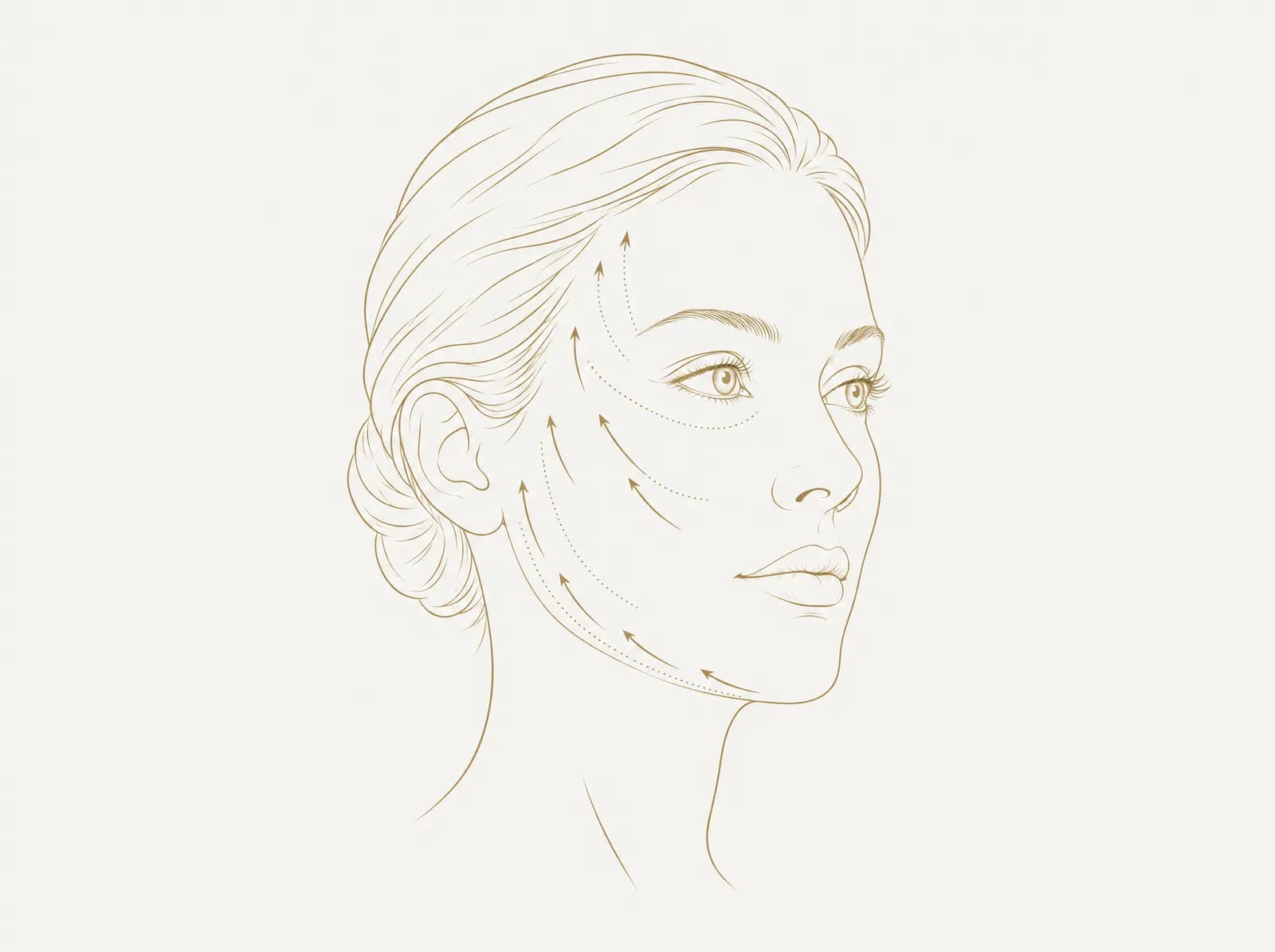
A mini-incision lift is a short-scar lift: from a small temple cut, the surgeon raises sagging skin and the SMAS, the firm layer beneath, in selected areas such as cheeks, smile lines and mouth corners, but barely changes the neck. It takes about 1 hour under sedation, with about a week of downtime; plan 7 to 10 days in Seoul.
Who is a good candidate for a mini-incision lift?
- Sagging has started in particular places, such as the cheeks, the smile lines or the corners of the mouth
- You are in your 20s to 40s. The clinic’s text names this age group for its shorter lifts, mainly for the lower face
- You want a shorter scar near the temple rather than one that runs around the ear
- You have tried threads or devices and want a change that comes from surgery, with about a week of downtime
When it may not be the right choice
- Your neck has loose skin or bands. Short-scar lifts change the neck very little, so ask about a neck lift or an SMAS facelift
- Your mid face, jowls and neck have all dropped a lot. A full SMAS facelift usually fits better
- You want a lift with no incision at all. A thread lift or Ultherapy changes less but needs no cut
- You cannot give up smoking before and after the operation. Smoking makes poor healing near the temple incision more likely
Which method fits you?
The clinic offers two short-incision lifts with the same listed time and recovery, plus thread lifts. It describes the two lifts in very similar terms, though its mini-incision lift text stresses lifting selected sagging areas. How far each one reaches for your face, and why one is suggested over the other, is a question for the surgeon.
| Method | What happens | Suits | Downtime |
|---|---|---|---|
| Mini-incision lift | A small incision near the temple. Loose skin and muscle in the chosen areas are lifted up to the SMAS, fixed, and some skin is trimmed. | Sagging in particular areas, such as smile lines and mouth corners | About 1 week; stitches out on day 5 to 7 |
| Mini facelift (the clinic’s SMAS mini facelift) | Also through a short temple incision; skin and the SMAS are lifted over the lower face and some skin is trimmed. | Sagging mainly in the cheeks and lower face | About 1 week; stitches out on day 5 to 7 |
| Thread lift | Barbed threads are placed through needle holes. No skin is removed. | Early sagging, with a smaller and shorter-lived change | Daily life can continue, according to the clinic |
What happens on the day of a mini-incision lift?
- Consultation. The surgeon looks at where the sagging sits, how firm your skin is and how much fat and muscle there is, then marks the areas to lift.
- Sedation. You stay drowsy through roughly an hour of surgery, and the clinic lists no overnight stay.
- Through the small incision near the temple, the surgeon lifts the loose skin and muscle in the marked areas, fixes the SMAS layer in its new position and trims a little skin.
- Fine stitches close the cut at the temple. Since the clinic lists no hospital stay, you rest at your hotel that night.
What is recovery like after a mini-incision lift?
- Days 1 to 3
- The temples and cheeks swell and feel tight, and bruising can spread toward the eyes. Sleep with your head raised and use cold packs only as the surgeon advises.
- Days 5 to 7
- The temple stitches are taken out at the check. Hair and sunglasses help while bruising fades, and daily routines usually resume around the end of the first week.
- Weeks 2 to 4
- The lifted areas still feel tight, and the skin beside the incision may stay numb or firm for a while.
- Months 3 to 6
- Most swelling has gone, and the temple scar continues to soften and fade.
How long should you stay in Seoul after a mini-incision lift?
The incision sits at the temple, and your surgeon can show you exactly where yours will be. Plan 7 to 10 days in Seoul: the temple stitches are taken out between day 5 and day 7, the flight usually follows around day 8, and the clinic’s 2 to 3 follow-up visits should be scheduled before you book. If one side of your face swells fast, or you have trouble breathing or swallowing, chest pain or sudden weakness on one side of the face, get emergency care first, then tell the clinic.
What are the risks of a mini-incision lift?
- Bleeding under the lifted skin (hematoma), which may have to be drained. Swelling that grows fast on one side, or severe pain, is the warning sign
- Injury to a branch of the facial nerve near the temple, which can weaken the forehead or another part of the face
- A visible, widened or thick scar, or thinning hair near the temple incision
- Numbness, asymmetry, or a small fold of extra skin (a dog-ear) near the incision
- A smaller change than a full facelift. A shorter lift reaches less tissue and the face keeps aging, so some people later want a touch-up or a fuller lift
- Infection, poor healing, and the general risks of sedation
What affects the cost of a mini-incision lift in Korea?
For a mini-incision lift, the quote depends mainly on how many areas are lifted and on anything added, such as fat grafting, threads or fillers. There is no set price on this page; the surgeon reviews your photos before any quote. Ask for a written quote naming the surgeon, the areas to be lifted, and the sedation, follow-up visits and stitch removal.
More questions
Is a mini-incision lift the same as a mini facelift?
They overlap. Both work through a short temple incision, and the clinic lists the same time and recovery for both. Its description of the mini-incision lift stresses lifting selected areas, such as smile lines and mouth corners, while its description of the mini facelift covers lifting the lower face. Which one fits your face is for the surgeon to judge.
What is a short-scar lift?
A short-scar facelift is a facelift done through a shorter incision instead of one that runs around and behind the ear. At the clinic, the cut sits at the temple. It suits mild sagging of the cheeks and lower face, but it cannot change the neck much.
When can I fly home after a mini-incision lift?
Usually around day 8, once the temple stitches are out and the incision has been checked. On the plane, keep your head raised when you rest, walk the aisle when you can, and carry the clinic’s contact details.
How long does a mini-incision lift last?
There is no fixed number. Aging continues, and a shorter lift reaches less tissue than a full facelift, so the change is smaller, and some people later want a touch-up. How long it holds depends on your skin and how you age; the surgeon can set realistic expectations for your face.
Related procedures
Sources
- Clinic figures as published by Urban Plastic Surgery, collected October 3, 2026. Your surgeon confirms your own plan.
- A clinical retrospective study comparing two short-scar face lifts: minimal access cranial suspension versus lateral SMASectomy. PubMed, US National Library of Medicine
- Minimal incision rhytidectomy (short scar face lift) with lateral SMASectomy: evolution and application. PubMed, US National Library of Medicine
- The S-Plus lift: a short-scar, long-flap rhytidectomy. PubMed Central, US National Library of Medicine
- Minilifting: Short-Scar Rhytidectomy with Thread Lifting. PubMed Central, US National Library of Medicine
- Cervicofacial Rhytidectomy. StatPearls, NCBI Bookshelf
Cases and clinic figures come from our partner clinic, Urban Plastic Surgery. The partnership does not change what we publish about risks and recovery.