Fat transfer breast augmentation in Korea
Fat transfer breast augmentation takes your own fat by liposuction from the abdomen, waist or thighs and injects it into the breasts. It suits a modest size increase without an implant; part of the fat is reabsorbed. Our partner clinic lists about 2 hours under general anesthesia or sedation, with same-day discharge. Plan 7 to 10 days in Seoul.
- Surgery time
- About 2 hoursUrban Plastic Surgery
- Anesthesia
- General anesthesia or sedationUrban Plastic Surgery
- Time in Seoul
- 7 to 10 days in SeoulGeneral guidance
Questions about your own plan? A patient coordinator replies first, free of charge, then connects you with the partner clinic.

Who is a good candidate for fat transfer breast augmentation?
- You want a small, soft increase in breast size and would rather not have an implant
- You have enough spare fat on the abdomen, waist or thighs, and would like those areas slimmer too
- You want to even out a difference between the breasts, or add fullness at the outer side of the breast
- You are having implants removed or replaced and want some volume restored with your own fat
When it may not be the right choice
- You are very lean, so there is too little fat to take
- You want a large change in size. An implant, or an implant combined with fat, does more
- Your breasts sag markedly. Added fat does not lift them, and a breast lift may be needed
- You are pregnant or breastfeeding, or your weight is still changing
Which parts of the breast can fat transfer fill?
Fat can go into the whole breast or into one part of it. The clinic lists the uses below on its English page. Which areas suit you depends on where you lack volume and how much fat you can spare.
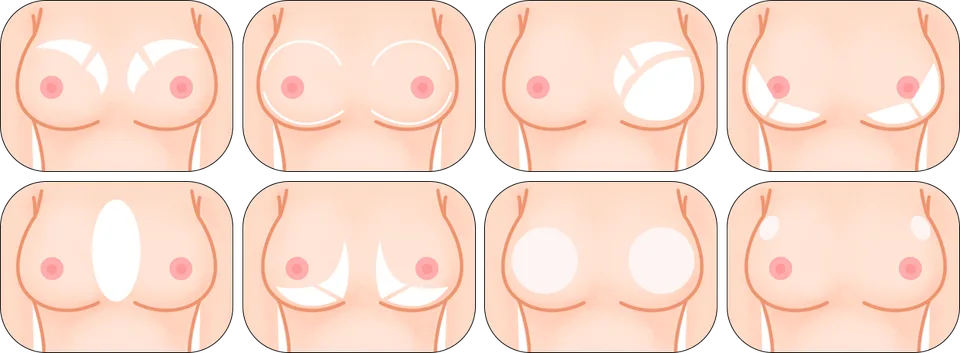
Upper breast
Fullness above the nipple, where the breast can look flat or hollow.
Whole breast
Fat spread through the entire breast for an overall, modest gain in size.
Uneven breasts
More fat on the smaller side, to bring the two breasts closer in size.
Outer breast
Volume added along the outer side of the breast.
Cleavage
Fat placed toward the middle of the chest, or along the middle and lower breast, so the inner edges look fuller.
Reconstruction and implant revision
Your own fat used to restore volume after breast reconstruction, or when implants are taken out or changed.
One specific spot
A single dip or flat area in one part of the breast.
Image: Urban Plastic Surgery’s English breast fat grafting page, collected 5 October 2026. The area notes are our own wording of the clinic’s list.
Which method fits you?
Urban Plastic Surgery, our partner clinic, offers breast fat transfer as one of three ways to add breast volume. The fat is spun to separate it from fluid and impurities, then placed in small amounts through a very thin cannula across several layers of the breast. The clinic explains that fat injected in large clumps is more likely to die (fat necrosis), and that it uses freshly taken fat in the amount needed, without freezing any.
| Method | What happens | Suits | Downtime |
|---|---|---|---|
| Fat transfer | Fat is taken by liposuction, purified, then injected through a fine cannula in small amounts across several layers of the breast. | A gentle size increase, a soft feel, evening out the two sides | 3 to 4 days to daily life; sore donor areas |
| Implant plus fat (hybrid) | An implant sets the main size, and fat softens the edges or fills a hollow upper breast. | A larger change with a softer outline, or more fullness at the upper breast | Recovery from both an implant and liposuction |
| Implant augmentation | A silicone implant is placed through a short incision. | A larger, more definite size increase | Light activity after 3 to 4 days; implant checks over the years |
What happens on the day of fat transfer breast augmentation?
- Consultation. The surgeon checks your breasts, your skin and how much fat you have to spare, and agrees on the donor areas and the size change with you. Bring a list of your medicines and past operations, and mention raised blood pressure, asthma, allergies or bad reactions to drugs; you may be asked to stop some medicines for a while.
- Shower before you come, wear loose clothes, and take off jewelry, piercings and nail polish. Have no food, water, gum or coffee for at least 6 hours; for general anesthesia, nothing after midnight. You are then given general anesthesia or sedation.
- Fat is removed by liposuction, cleaned of blood and fluid, and injected evenly in small amounts through a fine cannula. The clinic lists about 2 hours for the operation.
- The small openings are closed and you leave the same day, with compression on the donor areas.
What is recovery like after fat transfer breast augmentation?
- Days 1 to 3
- Bruising and soreness affect the donor areas as well as the breasts. Wear the compression garment and walk a little each day.
- Days 3 to 4
- Most people return to light daily activities.
- Days 7 to 8
- The clinic lists stitch removal at day 7, with a check-up of the breasts and the donor areas. Swelling makes the breasts look larger than their final size.
- Weeks 3 to 4
- The clinic advises waiting until about week 3 before hard workouts. Drinking and smoking slow healing, so leave both alone for a month or longer.
- Months 3 to 4
- Part of the fat is reabsorbed and the swelling settles. The clinic says most of the settling happens within 3 to 4 months, so the size you keep shows only then.
How long should you stay in Seoul after fat transfer breast augmentation?
Plan 7 to 10 days in Seoul. The small stitches come out at day 7, and at that visit the clinic also looks at the breasts and the donor areas, which is usually the last visit before your flight. The clinic counts 3 to 4 visits overall, so settle in advance which happen in Seoul. Wear the compression garment on the plane, walk the aisle and drink water. If a treated area blisters, or you see spreading redness, heat or fever, contact the clinic straight away. The clot warning in the risks list matters most on the flight home.
What are the risks of fat transfer breast augmentation?
- Some of the fat is reabsorbed, so the breasts end up smaller than they look in the first weeks, and a second session is sometimes discussed
- Fat that does not survive can form firm lumps (fat necrosis) or oil cysts, which may need scans or a needle test to check. The clinic notes that lumps are more likely when too much fat goes into one spot
- Calcifications that show on mammograms. Tell anyone who screens your breasts that you have had fat transfer
- Uneven breasts, or an uneven or dented surface in the donor areas
- Bleeding that collects under the skin of a breast or the abdomen (a hematoma). If one side swells quickly and becomes more painful, especially soon after surgery, contact the clinic straight away; if you cannot reach the clinic, get emergency care. This advice is not for a leg: if a leg becomes painful and swollen after fat is taken from the thighs, it can be a clot, so get emergency care first, then tell the clinic
- Infection, numbness or changes in breast sensation
- A clot in a leg vein that can travel to the lungs, more likely if you sit through a long flight in the first days, and the risks of anesthesia. If you become breathless, have chest pain, or one leg becomes painful and swollen, get emergency care first, then tell the clinic, and do not fly until a doctor says it is safe.
What affects the cost of fat transfer breast augmentation in Korea?
The number of donor areas, the amount of fat transferred and the type of anesthesia affect a fat transfer quote most. No price is listed yet; the clinic works from photos of your breasts and the donor areas. In writing, check the surgeon’s name, the donor areas, the compression garment, follow-up visits and stitch removal.
More questions
How much bigger can fat transfer make my breasts?
The change is modest. The American Society of Plastic Surgeons describes it as an option for a relatively small increase in size. How much depends on the fat you can spare, how much your skin can stretch, and how much of the fat survives. If you want a large change, ask about an implant or an implant with fat.
What do mammograms after fat transfer show?
They can show oil cysts, firm areas and calcifications left by the transferred fat. Radiologists can often tell these apart from signs of cancer, but extra imaging or a needle test is sometimes needed to be sure. Tell anyone who screens your breasts about the fat transfer, and keep your operation notes.
How long does breast fat transfer last?
Part of the fat is reabsorbed in the first months, and how much stays varies from person to person. According to the clinic, the volume has mostly settled by 3 to 4 months, and what remains after that generally stays unless you lose a lot of weight. Ask the surgeon whether a second session is ever needed.
Can I have implants later if I have fat transfer first?
Yes, the clinic says implants can be placed later. Tell the surgeon about the fat transfer before any later breast surgery, and bring your records.
Related procedures
Sources
- Clinic figures as published by Urban Plastic Surgery, collected October 8, 2026. Your surgeon confirms your own plan.
- Fat Transfer Breast Augmentation. American Society of Plastic Surgeons
- Fat Transfer Breast Augmentation Risks and Safety. American Society of Plastic Surgeons
- Fat transfer for breast augmentation: The ins and outs of this implant alternative. American Society of Plastic Surgeons
- Autologous fat grafting in breast reconstruction: implications for follow-up and surveillance. PubMed Central, US National Library of Medicine
Cases and clinic figures come from our partner clinic, Urban Plastic Surgery. The partnership does not change what we publish about risks and recovery.